Troubleshooting Common Pool Filter Issues: 7 Steps
Table of Contents
- Understanding Your Pool Filter System
- Why Your Pool Filter Pressure Gauge Reads High
- Fixing Low Water Flow When Your Pool Pump Is Not Circulating Water
- How to Backwash a Pool Filter Correctly
- Addressing Air Leaks and System Noise
- Cloudy Water and Dirty Pool Filter Solutions
- Preventative Maintenance to Avoid Future Issues
- Conclusion
- Frequently Asked Questions
Last Updated: September 30, 2026
Understanding Your Pool Filter System
A pool filter is the heart of your water circulation system. It removes debris, algae, and contaminants to keep your pool safe and clear. Most residential pools use one of three filter types: sand filters, cartridge filters, or diatomaceous earth (DE) filters. Each works differently, but all require regular maintenance to function properly.
The most common pool filter issues stem from three causes: improper maintenance, incorrect pump sizing, and neglected preventative care.
Your pump pulls water through the skimmer basket and pump basket, pushes it through the filter media to trap debris, then returns clean water to the pool. When any part of this cycle breaks down, your water becomes cloudy or dirty.
Why Your Pool Filter Pressure Gauge Reads High
High pressure on your filter gauge signals that water is struggling to pass through the filter media. According to Water Conditioning & Purification International's filter maintenance standards, filter pressure should be addressed when it reaches 7-10 pounds per square inch above the starting pressure.
The most common culprit is a clogged filter. Dirt, algae, and debris accumulate in the media over time. As the buildup increases, water flow slows and pressure climbs. Sand filters, cartridge filters, and DE filters all follow this pattern.
A second cause is an improperly sized pump. Research from Filter Basics guide on common pool filtration problems shows that pumps not matched to the filter's design flow rate are a primary cause of filtration failure. An oversized pump forces water through the media faster than it can filter effectively, driving pressure up.
Air in the system can also spike pressure. Turn the air relief valve counterclockwise until water sprays out, then close it.
Check these in order:
- Clean or backwash the filter media
- Verify pump size matches filter specifications
- Open the air relief valve to release trapped air
- Inspect the multiport valve for proper position
Fixing Low Water Flow When Your Pool Pump Is Not Circulating Water
Low flow means water barely returns to the pool despite the pump running. This is a circulation problem, distinct from high pressure issues.
The suction side is the weak link. A clogged skimmer basket or pump basket blocks suction immediately. Empty both baskets weekly during heavy use.
Air leaks on the suction side prevent the pump from priming and drop flow. Check all connections on the intake line for cracks or loose fittings, tighten hose clamps, and inspect rubber seals.
A worn impeller (the spinning part that moves water) reduces flow even when the pump runs and requires pump replacement.
Quick diagnostic steps:
- Empty the skimmer basket and pump basket
- Check suction-side connections for air leaks
- Listen for unusual pump noise (indicates cavitation from air)
- Verify the multiport valve is set to "Filter" mode, not "Waste"
How to Backwash a Pool Filter Correctly
Backwashing reverses water flow through the filter media to flush out trapped debris. Sand and DE filters can be backwashed; cartridge filters must be removed and rinsed or replaced.
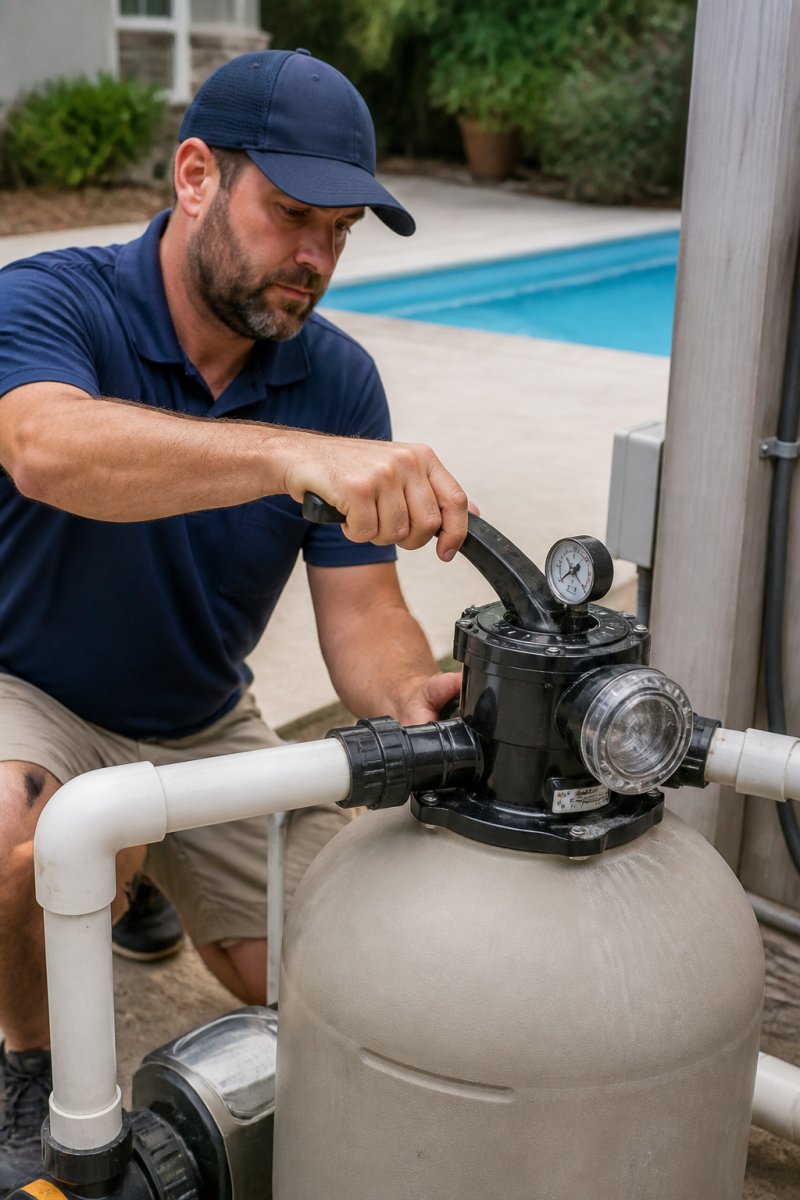
Backwashing steps:
-
Turn off the pump. Never switch the multiport valve while the pump runs. Pressure inside the system can damage the valve.
-
Open the air relief valve. Turn it counterclockwise until water drips out. This prevents pressure spikes.
-
Move the multiport valve handle to "Backwash." The handle should point directly at the "Backwash" position. Some older valves require a lever instead of a handle.
-
Turn the pump on. Water now flows backward through the filter media. Watch the sight glass (the clear tube on the filter tank). Water inside it will turn dark as debris flushes out.
-
Run for 3-5 minutes until water in the sight glass runs clear. For heavily soiled filters, this may take longer.
-
Turn off the pump again. Switch the multiport valve to "Rinse." This clears debris from the valve itself.
-
Run for 1 minute. Then turn off the pump.
-
Return the valve to "Filter." Close the air relief valve. Restart the pump.
Addressing Air Leaks and System Noise
Air in the system causes noise, reduced flow, and pressure spikes. Air may enter on the suction side (before the pump) or be trapped inside the filter tank, each requires a different fix.
System noise troubleshooting:
- Humming or buzzing = pump cavitation (air in suction line); stop the pump immediately and check water level and suction-side connections
- Grinding or squealing = impeller damage or debris in pump housing; stop immediately to avoid seal damage
- Rattling = loose clamp band, mounting bolts, or vibration against nearby equipment; tighten all visible fasteners
- Whistling or hissing = air leak near pump intake or multiport valve; trace the sound and inspect fittings
Diagnostic sequence for air leaks:
- Check pool water level and top off if low
- Inspect suction-side plumbing for cracks and loose connections
- Remove and inspect the pump lid O-ring; replace if cracked
- Open the air relief valve on the filter tank to release trapped pressure
- Listen for unusual pump noise during operation
- If noise persists, stop the pump and call a professional, impeller damage requires replacement
Cloudy Water and Dirty Pool Filter Solutions
Sand filters: Sand filters work best with specific sand grades (typically 20-40 mesh for residential pools). Using the wrong grade reduces flow or allows particles to escape. Check your filter manual for the correct specification and verify the sand matches.
- Water is moving but dirty = filtration efficiency issue. Pressure is normal, flow is normal, but particles pass through. Cause: wrong filter media, media is worn, or chemistry is poor. Fix: clean/replace media, balance chemicals, or upgrade filter type.
- Water isn't moving = circulation or clogging issue. Pressure is high or pump is weak. Water barely returns to the pool. Cause: clogged filter, air leak, or pump failure. Fix: backwash, check for air leaks, or service pump.
Cloudy water troubleshooting checklist:
- Test and balance chlorine (1-3 ppm), pH (7.2-7.6), and alkalinity (80-120 ppm)
- Check filter pressure; if normal, the issue is likely chemistry or media condition
- For sand filters, verify sand grade matches the manual specification
- For cartridge filters, remove and rinse or soak the cartridge in diluted acid
- For DE filters, confirm fresh DE powder was added after the last backwash
- Verify the filter media is not at end of life (sand and DE: 5+ years; cartridge: 2-3 years)
- Confirm the multiport valve is set to "Filter" mode, not "Waste" or "Recirculate"
Preventative Maintenance to Avoid Future Issues
Weekly tasks:
- Empty the skimmer basket and pump basket
- Check the filter pressure gauge
- Test water chemistry and adjust as needed
Monthly tasks:
- Inspect all visible plumbing for cracks or loose connections
- Clean the pump strainer basket if it has one
- Monitor the air relief valve for leaks
Seasonal tasks:
- Before opening, inspect the multiport valve and lubricate the handle
- Before closing, clean the filter thoroughly and lower water level
- Check the pump lid O-ring and replace if cracked
Annual tasks:
- Have a professional inspect the pump impeller and seals
- Replace the filter media if it's over five years old
- Inspect the clamp band for corrosion and tighten bolts
Rather than managing these tasks yourself, consider a Weekly Pool Maintenance Programs from EcoClean Pool Services. Our technicians diagnose complex issues that homeowners often misidentify, saving you time and money. We also offer Filter Cleaning and Weekly Pool Chemical Management to keep your water balanced and your equipment running efficiently year-round.
Conclusion
Pool filter problems are frustrating, but most are fixable with the right diagnosis. High pressure, low flow, air leaks, and cloudy water each have specific causes and solutions.
Frequently Asked Questions
Why is my pool filter pressure gauge reading high?
High pressure occurs when filter media becomes clogged with debris, restricting water flow. Standard maintenance calls for backwashing or cleaning when pressure rises 7-10 psi above your starting pressure. Check the pressure gauge regularly and backwash immediately when you hit that threshold. A clogged filter forces your pump to work harder, reducing circulation efficiency and potentially causing equipment damage.
What should I do if my pool pump is not circulating water?
First, check that the pump is running and the power switch is on. Next, inspect the skimmer basket and pump basket for debris blocking the suction side. If those are clear, check for air leaks around the pump lid and O-ring seals, which prevent proper priming. Air in the system stops circulation completely. Bleed air using the relief valve at the top of the filter tank. If circulation doesn't resume, the impeller may be damaged and require professional repair.
How often should I backwash my pool filter?
Backwash when your pressure gauge reads 7-10 psi above the baseline pressure when the filter was new or recently cleaned. Most residential pools need backwashing every 2-4 weeks depending on debris load and filter type. Sand filters require backwashing more frequently than cartridge or DE filters. Check your pressure gauge weekly to stay ahead of buildup and maintain optimal filtration efficiency and water circulation.
Can a dirty pool filter cause cloudy water?
Yes. A clogged filter cannot trap fine particles and algae, allowing them to pass back into the pool. Cloudy water often signals poor filtration rather than equipment failure. Before assuming your filter is broken, test your water chemistry, algae presence is frequently misdiagnosed as a mechanical defect. If chemistry is balanced but water remains cloudy, backwash immediately and run the filter continuously for 24 hours. If cloudiness persists, the filter media may need replacement.


Comments
Post a Comment