Eco-Friendly Pool Cleaning Methods: A 2026 Guide
Table of Contents
- Why Eco-Friendly Pool Cleaning Matters Now
- UV and Ozone Sanitization Systems for Chemical-Free Water
- Benefits of Saltwater Pool Systems
- How to Reduce Chlorine Usage in Pools
- Variable Speed Pool Pump Energy Savings
- Natural Algaecides and Enzyme-Based Cleaners
- Water Conservation and Long-Term Sustainability
- Conclusion
- Frequently Asked Questions
Last Updated: September 25, 2026
Why Eco-Friendly Pool Cleaning Matters Now
The swimming pool cleaning machines market reached $3.787 billion in 2026, up from $2.713 billion in 2021 (Cognitive Market Research, 2026). The conversation is no longer about whether eco-friendly pool cleaning methods work, it's about why you'd choose anything else.
At EcoClean Pool Services, Llc., we've watched this transition accelerate across residential pools. Families are asking harder questions about chemical exposure, long-term costs, and environmental impact. The data backs their concerns. A Life Cycle Assessment from ScienceDirect revealed that chemical usage and energy consumption drive both the environmental costs and the financial burden of residential pool maintenance.
The real opportunity isn't just about reducing chemicals. It's about fundamentally rethinking how your pool operates. Eco-friendly pool cleaning methods can significantly cut chemical reliance while maintaining water safety and clarity. That's not a marginal improvement, it's a complete system redesign.
UV and Ozone Sanitization Systems for Chemical-Free Water
UV and ozone systems eliminate microorganisms through physical and chemical processes rather than relying on chlorine residuals. UV light damages the DNA of algae and bacteria, while ozone generators create a powerful oxidizer that destroys contaminants on contact. Both achieve a high germicide kill rate.
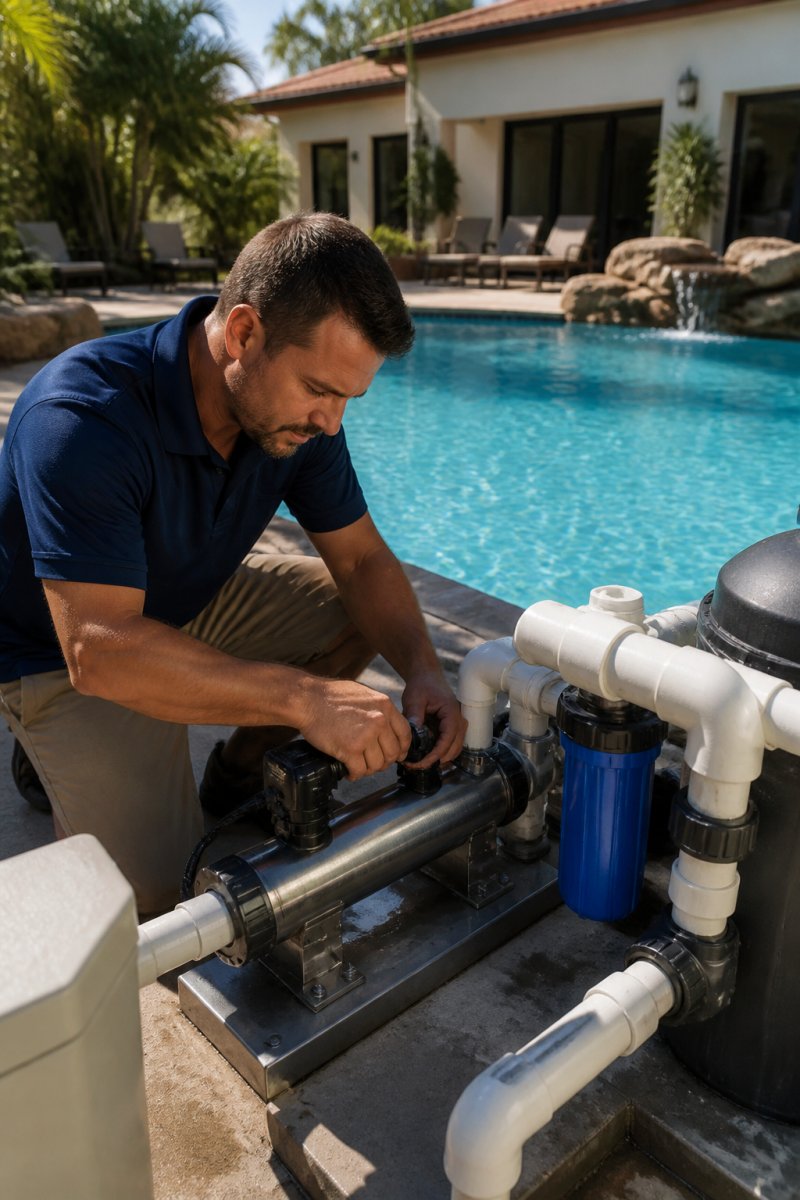
These systems leave no chemical residual. Once UV light passes through water or ozone dissipates, the sanitization is complete, no chlorine smell, no skin irritation, and no long-term chemical accumulation.
The tradeoff: UV and ozone systems require consistent operation and proper filtration. They work best when water chemistry is already balanced. Aging equipment or undersized filtration makes retrofitting more complex.
For homeowners considering this upgrade, the installation typically requires professional assessment. EcoClean Pool Services, Llc. specializes in Pool Ozone and Ultra Violet Water Treatment system installations, evaluating your existing equipment and designing a system that integrates with your current setup.
Benefits of Saltwater Pool Systems
Saltwater chlorination converts dissolved salt into chlorine through electrolysis, maintaining consistent sanitization without manual chemical additions. This eliminates the constant cycle of testing, purchasing, and balancing chlorine levels.
Saltwater systems reduce chemical waste by eliminating frequent chlorine purchases and associated packaging.
The Financial Reality: 5-Year Cost Comparison
Most guides skip the ROI calculation, but homeowners need it to justify the switch. Here's what the numbers typically look like:
Traditional chlorine pool (average 15,000 gallons):
- Annual chlorine purchases: $400-$600
- Testing strips and pH adjusters: $150-$250
- Labor (if professional maintenance): $1,200-$2,400 annually
- 5-year total: $8,000-$16,500
Saltwater system conversion:
- Equipment and installation: $1,500-$3,500 (varies by pool size and existing plumbing)
- Annual salt purchases: $100-$200
- Cell replacement (every 3-7 years): $500-$1,200 per cell
- Testing and minor adjustments: $100-$150 annually
- 5-year total: $3,500-$7,000 (including one cell replacement)
The payback period can vary depending on your current maintenance approach and local chlorine prices.
What Most Homeowners Don't Realize About Saltwater Maintenance
Saltwater systems require stable pH and alkalinity to function efficiently. The system automates chlorine generation but doesn't eliminate water chemistry management, you're trading frequent chlorine purchases for consistent monitoring of pH, alkalinity, and salt levels.
Saltwater cells require regular cleaning every 3-6 months to prevent mineral buildup. Cell replacement at 3-7 years costs $500-$1,200 per cell.
The Corrosion Factor
Saltwater corrodes steel railings, metal light fixtures, and some pump components. Verify that pool deck, railings, and metal fixtures are stainless steel or salt-coated before installation.
Best Candidates for Saltwater Conversion
Saltwater systems work best for:
- Pools with stable water chemistry and established filtration systems
- Homeowners committed to monthly monitoring and seasonal cell cleaning
- Regions with high chlorine costs or limited chemical availability
- Families seeking softer water and reduced chemical odor
They're less ideal for:
- Pools with aging equipment that may corrode
- Homeowners unwilling to monitor water chemistry regularly
- Pools in areas with naturally hard water (mineral buildup accelerates)
- Small pools where the upfront cost relative to savings is less favorable
How to Reduce Chlorine Usage in Pools
Combining multiple strategies reduces chlorine usage. Biodegradable enzymes, mineral sanitizers, and pH-neutral treatments can significantly cut pool chemicals.
Enzyme-based cleaners break down organic contaminants, sunscreen, sweat, leaves, body oils, that chlorine would otherwise target, reducing chlorine demand. Mineral sanitizers use copper and silver ions to suppress algae and bacteria growth while lowering chlorine residuals.
The process for reducing chlorine usage:
- Test your current water chemistry, baseline alkalinity, pH, and chlorine levels
- Install a quality filtration system, cleaner water requires less chemical intervention
- Add enzyme treatments weekly, these work continuously to break down organic matter
- Introduce mineral sanitizers, reduce chlorine dependency while maintaining germicide effectiveness
- Monitor water balance weekly, pH and alkalinity directly impact chlorine efficiency
- Adjust chlorine levels downward gradually, don't eliminate it entirely; use it as a backup sanitizer
The mistake is switching to a single alternative and expecting it to replace chlorine entirely.
Variable Speed Pool Pump Energy Savings
Pool pumps typically run 24/7, making them one of the largest energy consumers in your home. Variable speed pumps adjust motor speed based on demand, cutting energy consumption by 50-90% compared to traditional models.
Variable speed pool pump energy savings compound over time:
- Typical single-speed pump: 1.5-3 HP, running 24 hours = 36-72 kWh daily
- Variable speed equivalent: same filtration, 8-15 kWh daily at optimized speeds
- Annual savings: 7,000-23,000 kWh depending on your region and usage
Natural Algaecides and Enzyme-Based Cleaners
Enzyme-based cleaners use biological processes to break down organic compounds, while mineral algaecides rely on trace metals to suppress algae growth. Both work within a balanced water chemistry framework rather than replacing it.
How Enzyme Treatments Actually Work
Mineral Sanitizers: The Copper and Silver Alternative
The Integration Challenge: Why Enzymes Alone Aren't Enough
-
Filtration is non-negotiable. Enzymes break down organic matter, but your filter must remove the broken-down particles. A clogged or undersized filter defeats the purpose. You need a filter rated for at least one complete water turnover every 8-12 hours.
-
Circulation matters. Enzymes and minerals only work where water flows. Dead zones in your pool (corners, deep ends, under steps) won't receive treatment. A properly sized pump and circulation pattern ensures even distribution.
-
Water chemistry must be stable. pH between 7.2-7.6 and alkalinity between 80-120 ppm are non-negotiable. Enzyme efficiency drops dramatically outside these ranges. Mineral sanitizers become ineffective if pH exceeds 7.8.
-
You still need a backup sanitizer. Most pool professionals recommend maintaining a low chlorine residual (0.5-1.0 ppm) even when using enzymes and minerals. This provides a safety net if organic load spikes unexpectedly.
DIY Natural Filtration: An Emerging Alternative
For existing pools, retrofitting a bio-filter is possible but complex. A typical retrofit involves:
- Installing a separate circulation loop with a settling tank
- Adding a gravel and plant-filled filtration chamber (4-6 feet deep, 20-30% of pool volume)
- Planting aquatic plants (water lilies, reeds, cattails) that absorb excess nutrients
- Running water through the bio-filter continuously
When to Use Each Approach
Natural algaecides and enzyme-based cleaners work best when:
- Your filtration system is functioning properly and sized appropriately
- Water circulation is consistent throughout the pool
- pH and alkalinity are within target ranges (7.2-7.6 pH, 80-120 ppm alkalinity)
- You're applying treatments on a regular weekly schedule, not reactively
- Your pool sees moderate to light usage (fewer than 10 swimmers daily)
They're less effective for:
- Pools with poor circulation or dead zones
- High-usage commercial or resort pools with heavy organic load
- Pools in regions with algae-prone water sources
- Situations where you need immediate algae elimination
Water Conservation and Long-Term Sustainability
Evaporation and backwashing account for significant water loss, typically 25,000-30,000 gallons annually for a residential pool.
Conclusion
The shift toward eco-friendly pool cleaning methods represents a fundamental change in how homeowners approach pool maintenance. The technology works, the market is moving decisively in this direction, and the long-term economics favor sustainable approaches.
Frequently Asked Questions
Can I clean my pool without using chemicals?
Yes. UV and ozone sanitization systems achieve a high germicide kill rate without traditional chlorine. Enzyme-based cleaners and mineral sanitizers can significantly reduce chemical reliance. However, some form of sanitization, whether chemical or mechanical, is necessary to maintain safe water quality and prevent harmful microorganisms from growing.
What are the benefits of saltwater pool systems?
Saltwater systems generate chlorine naturally through electrolysis, reducing the need to manually add harsh chemicals. They lower chemical runoff into the environment, require less frequent water chemistry adjustments, and are gentler on skin and eyes. The upfront cost is higher, but long-term operating costs drop significantly because you buy less chlorine and sanitizer over time.
How much can variable-speed pumps actually save on energy costs?
Variable-speed pumps adjust their flow rate based on pool needs, using significantly less electricity than single-speed models during off-peak hours. While exact savings depend on your pool size and local electricity rates, these pumps are a key component of energy-efficient pool maintenance. Contact EcoClean Pool Services for a personalized energy audit and cost projection for your specific setup.
Is switching to eco-friendly methods more expensive than traditional pool maintenance?
Initial equipment costs for UV, ozone, or saltwater systems are higher than standard chlorine setups. However, the market for swimming pool cleaning machines reflects growing adoption of these systems. Long-term savings come from reduced chemical purchases, lower energy consumption with variable-speed pumps, and fewer water replacements. EcoClean Pool Services can assess your pool's current condition and provide a cost-benefit analysis for retrofitting.
Ready to transform your pool into a sustainable, low-chemical system? Contact EcoClean Pool Services, Llc. today for a comprehensive assessment of your pool equipment and personalized recommendations for reducing chemical usage while maintaining crystal-clear water.


Comments
Post a Comment