How to Balance Pool Chemicals Safely: 2026 Guide
Table of Contents
- What You'll Need Before You Start
- Step-by-Step: How to Balance Pool Chemicals Safely
- What Order to Add Pool Chemicals (And Why It Matters)
- Ideal Chemical Ranges and What They Mean
- Pool Chemical Safety Storage Tips
- How to Fix Green Pool Water
- Troubleshooting Common Water Problems by Appearance
- Frequently Asked Questions
Last Updated: September 20, 2026
What You'll Need Before You Start
Balancing pool chemicals safely starts with a simple rule: test first, add second, never guess. Most pool damage we see comes from adding chemicals without testing, and that mistake costs hundreds in repairs. This guide shows you how to balance pool chemicals safely, step by step, even if you've never done it before.
Gather these supplies before you touch a single chemical:
- A liquid reagent kit or fresh test strips
- Protective equipment: gloves, safety glasses, and long sleeves
- Sodium bicarbonate, muriatic acid, and calcium hardness increaser
- A stabilizer (cyanuric acid) if your levels run low
- A clean 5-gallon bucket that holds only pool chemicals
- A pool brush and a working filtration system
Step-by-Step: How to Balance Pool Chemicals Safely
Here's the short version: test your water, adjust total alkalinity first, then pH, then calcium hardness, then sanitizer. Retest after each adjustment. This order matters because each level affects the others.
Test Your Water First
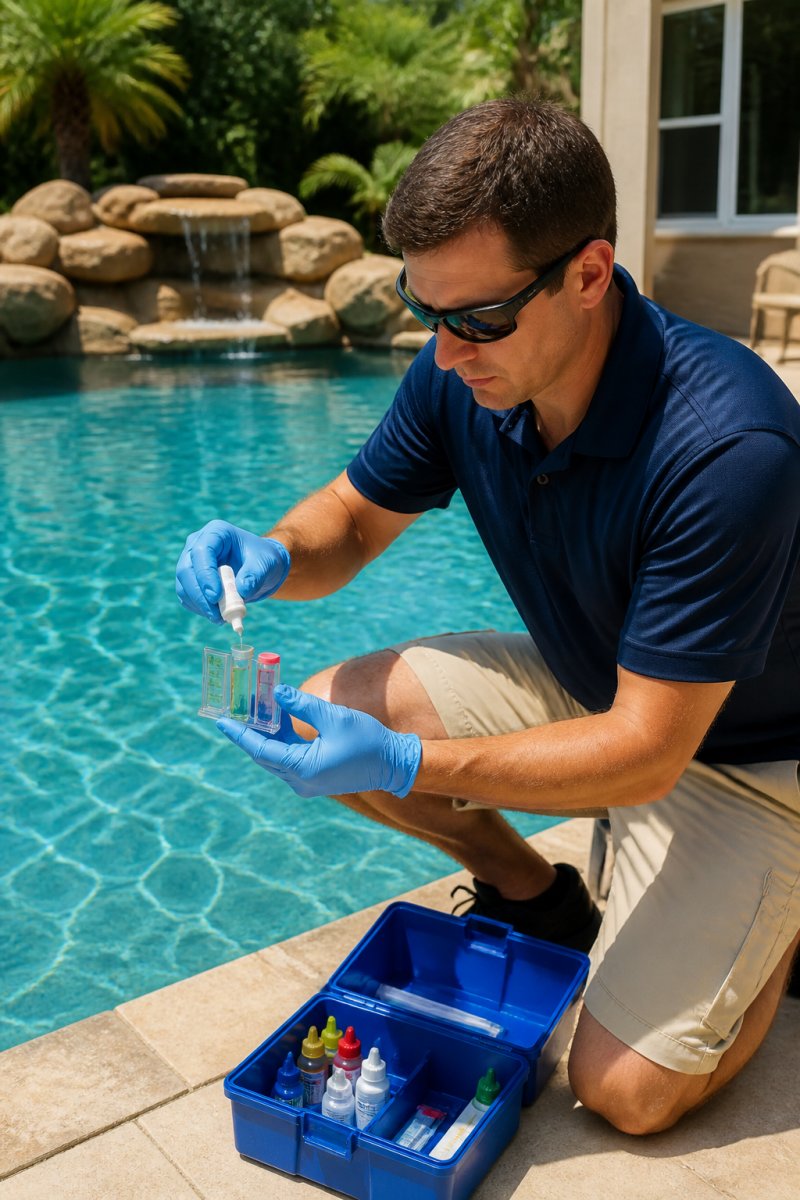
Test your pool water before you add anything, a liquid reagent kit gives more accurate results than strips. Test in the morning before swimmers get in, and record every reading in a notebook or app so you can spot trends. Test two to three times per week during swim season.
Adjust in the Right Order
Add chemicals one at a time, waiting between each. Here's the order that works:
- Balance total alkalinity to 80-120 ppm
- Adjust pH to 7.4-7.6
- Raise calcium hardness to 200-400 ppm
- Add stabilizer if cyanuric acid is low
- Add sanitizer last, then shock if needed
Circulate and Retest
Wait 24 hours, then retest. Small changes may need a second dose; large swings usually mean a dosage error, so recheck your pool volume before adding more.
What Order to Add Pool Chemicals (And Why It Matters)
The order matters because total alkalinity acts as a buffer. Adjust pH before alkalinity and your pH drifts back within hours, that's why experienced techs fix alkalinity first, every time.
Here's the full sequence:
| Step | Chemical | Target | Wait Time |
|---|---|---|---|
| 1 | Sodium bicarbonate | Raise total alkalinity | 4-6 hours |
| 2 | Muriatic acid or soda ash | Adjust pH | 4 hours |
| 3 | Calcium chloride | Raise calcium hardness | 24 hours |
| 4 | Cyanuric acid | Raise stabilizer | 24 hours |
| 5 | Chlorine or shock | Sanitize water | 8-24 hours |
Ideal Chemical Ranges and What They Mean
Every reading tells a story about your water. Here's what each means for how to balance pool chemicals safely.
pH Levels
pH measures how acidic or basic your water is. Aim for 7.4-7.6. Low pH is corrosive and irritates eyes and skin; high pH causes scaling and cloudy water. Test pH after every alkalinity adjustment.
Total Alkalinity
Total alkalinity is the water's ability to resist pH changes. Keep it at 80-120 ppm. Low alkalinity makes pH bounce wildly. High alkalinity locks pH in place and causes scaling. Sodium bicarbonate raises it. Muriatic acid lowers it.
Calcium Hardness
Calcium hardness is the amount of dissolved calcium in your water. Target 200-400 ppm. Low calcium pulls minerals from pool surfaces, which is corrosive; high calcium causes scaling and cloudy water. The saturation index combines pH, temperature, calcium hardness, and alkalinity into one number predicting scaling or corrosion risk.
Cyanuric Acid (Stabilizer)
Cyanuric acid protects chlorine from sunlight. Keep it at 30-50 ppm. Too little and chlorine vanishes by noon; too much and chlorine stops working, chlorine lock. The only fix for high CYA is draining and refilling part of the pool.
Pool Chemical Safety Storage Tips
Most guides treat chemical safety as a bullet list. That is a mistake. The real risk is not a single product, it is what happens when two products meet. Understanding the specific incompatibilities and correct responses turns a vague warning into usable knowledge.
Which Chemicals Are Dangerous to Mix
The table below covers the combinations that cause the most household incidents. "Mixing" includes pouring into the same bucket, storing on the same shelf where fumes can mingle, and adding one chemical while another is still dissolving.
| Combination | What Happens | Why |
|---|---|---|
| Muriatic acid + chlorine (liquid or tablet) | Releases chlorine gas | Acid drives the chlorine/chloride equilibrium toward free Cl₂ gas |
| Muriatic acid + sodium bicarbonate | Violent fizzing, splatter, heat | Acid-base neutralization releases CO₂ and heat fast |
| Calcium hypochlorite + trichlor tablets | Fire or explosion | Oxidizer meets a compatible fuel; heat and chlorine gas follow |
| Calcium hypochlorite + muriatic acid | Toxic chlorine gas | Same acid-driven release as above, often more violent |
| Cyanuric acid + chlorine in one bucket | Chlorine lock, poor dissolution | CYA binds free chlorine before it can sanitize |
| Any oxidizer + any acid | Gas release, heat, possible fire | Oxidizers donate oxygen; acids accelerate the reaction |
The Rule That Prevents Most Accidents
Add chemicals to water, never water to chemicals. Pouring water onto a concentrated acid or base can cause a flash boil and splatter. The same applies to granular shock: pre-dissolve it in a bucket of pool water, then pour the solution into the pool.
Storage That Actually Prevents Reactions
Store chemicals in a cool, dry place away from direct sunlight, off the ground on a shelf so a leak does not pool under the containers. Separate acids from oxidizers, ideally on different shelves, never in a sealed cabinet where fumes can accumulate.
- Keep all containers sealed and labeled with the original label intact
- Store acids and oxidizers on separate shelves, not just separate containers
- Never store chemicals in the pool pump room or any enclosed space with the heater
- Keep a dry chemical fire extinguisher (Class D or ABC rated for the products you store) nearby
- Lock the storage area if you have kids or pets
- Keep a dedicated 5-gallon bucket that holds only pool chemicals, never a household bucket
How to Fix Green Pool Water
Green water almost always means an algae bloom. The fix is shock treatment, not more chlorine tablets:
- Brush the walls and floor to loosen algae
- Balance pH to 7.2-7.4 first
- Add a shock dose based on your pool volume
- Run the pump 24 hours straight
- Clean or backwash the filter daily
- Retest and repeat if the water stays green
Troubleshooting Common Water Problems by Appearance
Your water's look tells you what is wrong before you even test, but appearance alone is a starting hypothesis, not a diagnosis. The table below pairs each symptom with the confirming test, the numeric threshold that matters, and the first fix. Always test before you dose.
| Water Appearance | Likely Cause | Confirm With | First Fix |
|---|---|---|---|
| Green | Algae bloom | Free chlorine below 1 ppm, CYA in range | Brush, balance pH to 7.2-7.4, shock |
| Cloudy white | High pH or high calcium | pH above 7.8, calcium above 400 ppm | Lower pH with muriatic acid, check hardness |
| Clear but stinging | Low pH | pH below 7.2 | Raise pH to 7.4-7.6 with soda ash |
| Foamy | High alkalinity or lotions | Alkalinity above 120 ppm | Lower alkalinity, shock to oxidize organics |
| Brown or tea-colored | Metals in water | Iron or copper present on a metals test | Metal sequestrant, then retest |
| Cloudy blue-green | Dead algae or filter issue | Filter pressure above clean baseline by 8-10 psi | Backwash or clean filter, retest |
| Scaling on tile or walls | High calcium or high pH | Calcium above 400 ppm, pH above 7.8 | Lower pH, partial drain if calcium is very high |
How to Read the Table
Start with the symptom, then run the confirming test before adding anything. A green pool with CYA above 70 ppm will not clear with shock alone, the chlorine is bound and cannot oxidize the algae. Partially drain and refill to bring CYA down to 30-50 ppm, then shock. This is the most common reason a shock treatment "does not work."
Regional Water Source Variations
Two neighbors can follow the same steps and get different results because their fill water is different.
When to Call a Professional
If the same problem returns within a week of a correct fix, the cause is usually equipment, not chemistry. A filter not backwashing properly, an undersized pump, or a malfunctioning UV/ozone system keeps chlorine demand high no matter how carefully you dose. Our Pool Equipment Repairs and Pool Ozone and Ultra Violet Water Treatment services can help reduce chemical use.
Frequently Asked Questions
What happens if you don't balance your chemicals before closing your pool?
If you skip balancing before closing, you risk starting the next season with algae, cloudy water, or scale. Imbalanced water can also damage your pool surfaces and equipment over the winter. Always test and adjust pH, alkalinity, and sanitizer levels before covering your pool to avoid costly cleanup in spring.
Is baking soda the same as pool stabilizer?
No, they are different. Baking soda (sodium bicarbonate) raises total alkalinity, which helps stabilize pH. Pool stabilizer (cyanuric acid) protects chlorine from sunlight. Using the wrong one can throw off your water balance. Always check labels and use the product that matches your test results.
What two pool chemicals should not be mixed?
Never mix chlorine and muriatic acid directly. Combining them can create dangerous toxic gas. Also, avoid mixing different chlorine types (like calcium hypochlorite and trichlor) as they can react violently. Always add chemicals separately to pool water, never to each other, and follow label directions carefully.
How often should you test your pool water?
Test pH and chlorine levels at least twice a week, and total alkalinity and calcium hardness weekly. During heavy use or after rain, test more often. Regular testing helps you catch imbalances early, keeping your pool safe and clear. Use test strips or a liquid reagent kit for accurate results.


Comments
Post a Comment