Signs Your Pool Pump Needs Repair: 2026 Guide
Table of Contents
- Signs Your Pool Pump Needs Repair: What to Watch For
- Unusual Noises from the Pump
- Reduced or No Water Flow
- Water Leaks Around the Pump Housing
- Circuit Breaker Tripping Repeatedly
- Troubleshoot Pool Pump Not Circulating Water
- Pool Pump Making Loud Grinding Noise: Causes and Fixes
- Average Cost of Pool Pump Repair in 2026
- DIY vs. Professional Repair: Safety First
- Preventative Maintenance Schedule to Avoid Repairs
- When to Repair vs. Replace Your Pool Pump
- Frequently Asked Questions
Last Updated: September 23, 2026
Signs Your Pool Pump Needs Repair: What to Watch For
Pool pump repair costs range from $100 to $700, according to Angi's pool pump repair cost data, which tells you something important: catching the problem early keeps you at the low end of that range. At EcoClean Pool Services, we've seen how quickly a small issue becomes a major expense.
Unusual Noises from the Pump
Grinding, screeching, or rattling sounds are the most common early warning signs your pool pump needs repair. These noises usually point to failing bearings, a clogged impeller, or debris trapped in the housing.
- Grinding: Worn bearings or debris in the impeller
- Screeching: The motor is running dry or overheating
- Rattling: Loose parts or cavitation
- Buzzing without water movement: A capacitor or electrical issue
Reduced or No Water Flow
A drop in water flow is one of the earliest indicators of a pump problem, often signaling issues with the impeller or circulation system, according to Pool Operation Management's repair guide. If your pool looks dull or the return jets feel weak, pay attention.
Check these first:
- Skimmer and pump baskets clogged with debris
- A dirty sand filter restricting flow
- A partially closed valve
- A failing impeller
Weak flow rarely fixes itself. It usually gets worse.
Water Leaks Around the Pump Housing
Visible water leaks and a noticeable drop in suction are the primary signs of a failed shaft seal, per Angi's repair cost breakdown. A leaking pump loses prime, pulls in air, and runs hotter than it should.
Circuit Breaker Tripping Repeatedly
A pump that trips the circuit breaker has an electrical problem, not a water problem. This is one of the signs your pool pump needs repair that you should never ignore.
Common causes include:
- A failing motor drawing too much amperage
- Moisture inside the electrical components
- A shorted wire or loose connection
- An undersized or aging breaker
Troubleshoot Pool Pump Not Circulating Water
When you troubleshoot pool pump not circulating water, start with the simplest causes. Most no-flow problems trace back to a clogged impeller or an air leak, not a dead motor.
Check the Impeller and Skimmer Baskets
Turn off the pump first. Then pull the skimmer and pump baskets and clear out leaves, hair, and debris. A packed basket starves the pump and kills flow.
Inspect for Air Leaks on the Suction Side
Air bubbles in the pump basket mean air is getting in on the suction side. That breaks the pump's prime and reduces circulation.
Pool Pump Making Loud Grinding Noise: Causes and Fixes
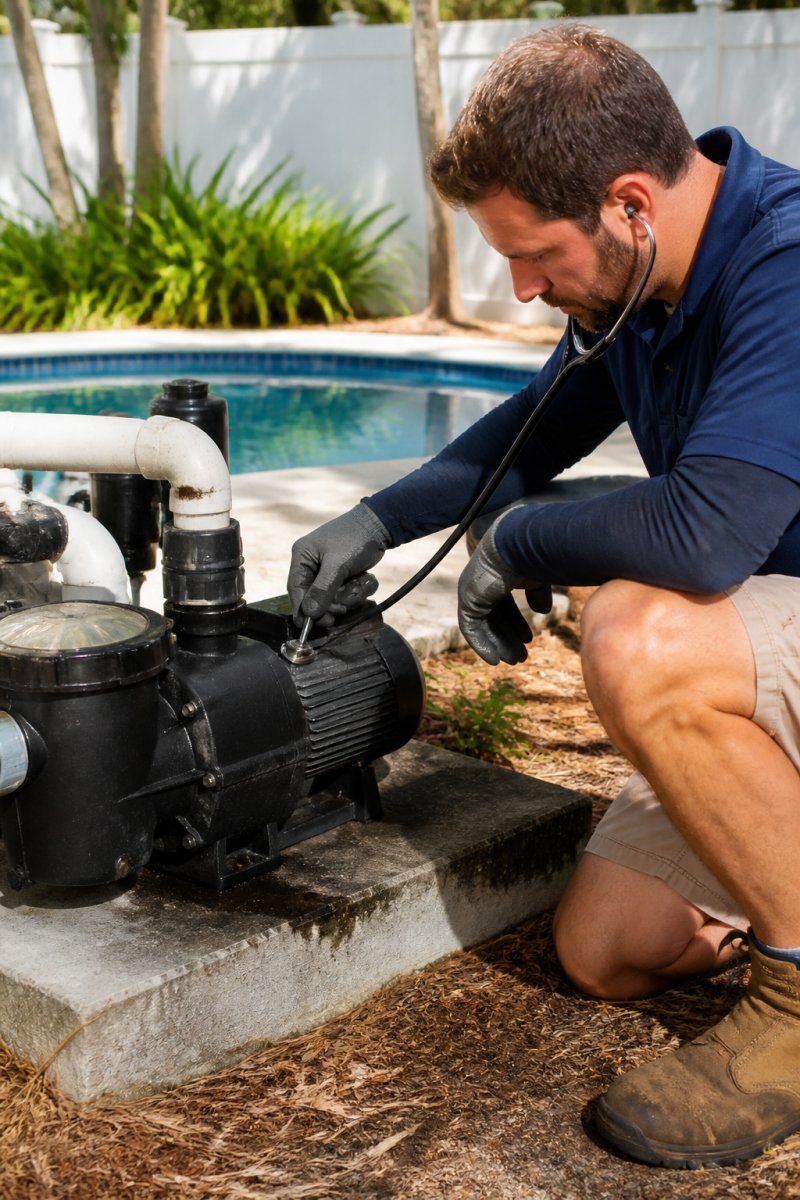
A pool pump making loud grinding noise almost always means worn bearings or debris in the impeller. The fix depends on which one it is, so diagnosis matters.
Bearing Noise vs. Cavitation
Bearing noise is a steady grind that gets louder as the pump runs. It comes from the motor and won't stop on its own. Bearings wear out with age, and replacement is the only real fix.
Average Cost of Pool Pump Repair in 2026
The average cost of pool pump repair ranges from $100 to $700 in 2026, according to Angi's national cost data. What you pay depends on the part that failed, and on whether you caught it early.
| Problem | Typical Cost Range | What Drives the Price |
|---|---|---|
| Motor replacement | $100 to $250 | Motor cost plus labor; most common repair |
| Shaft seal | Lower end of range | Cheap part, but labor to access the seal |
| Impeller cleaning | Lower end of range | Often a DIY-friendly fix |
| O-ring or gasket replacement | Lower end of range | Parts are inexpensive; labor is the cost |
| Capacitor replacement | Lower end of range | Small part, quick swap |
| Electrical fault | Mid to high range | Requires a licensed pro and diagnostic time |
| Full pump replacement | Above repair range | When repair no longer makes sense |
What Actually Drives the Cost
Three factors move the number more than anything else:
1. Which part failed. A capacitor or O-ring is a parts-counter item. A motor or sealed bearing is a bench job. The gap between them is the gap between the low and high end of the range.
The Visual Diagnostic: Where the Leak Is Matters
- Water weeping at the seam between the motor and the pump housing: shaft seal. This is the classic failure point and the one that damages the motor if ignored.
- Water at the union or threaded fittings: O-ring or union gasket. Cheapest fix on the list.
- Water at the housing body itself: cracked housing or housing gasket. More involved, because the pump has to come apart.
- Water only when the pump is off: often a suction-side air leak rather than a pressure-side leak. Different diagnosis entirely.
Seal and motor issues drive most of the cost. A planned repair almost always costs less than an emergency replacement, and catching the leak at the seal instead of the motor is the single biggest lever you have on the final number.
DIY vs. Professional Repair: Safety First
Some fixes are safe to do yourself. Others are not. Knowing the line protects both your pump and your family.
Safe DIY tasks:
- Clearing skimmer and pump baskets
- Cleaning the impeller
- Replacing O-rings and gaskets
- Checking for visible leaks
Leave these to a pro:
- Any electrical work or breaker issues
- Motor and bearing replacement
- Seal replacement inside the housing
- Anything involving voltage or amperage testing
Preventative Maintenance Schedule to Avoid Repairs
Most pump failures are preventable. A simple schedule catches small problems before they become the signs your pool pump needs repair.
- Weekly: Clear skimmer and pump baskets
- Monthly: Check for leaks and listen for new noises
- Monthly: Inspect O-rings and gaskets
- Quarterly: Clean the filter and check pressure
- Seasonally: Have a pro inspect the motor and electrical parts
When to Repair vs. Replace Your Pool Pump
Repair makes sense when the pump is under 8 to 10 years old and the fix is a single part. Replace it when repairs pile up or the motor is failing. That's the short version. The longer version is where most homeowners leave money on the table.
Use this framework instead of guessing.
The 50% Rule
If the repair estimate is more than half the cost of a new pump, replacement usually wins. A motor replacement on a 12-year-old single-speed pump is a repair you'll repeat. The same motor replacement on a 5-year-old pump is money well spent.
Age and Part Availability
Most residential pool pumps are designed for a 8 to 12 year service life. Past 10 years, three things happen at once:
- Seals, gaskets, and impellers get harder to source
- The motor's efficiency has already degraded
- The next failure is usually the one that strands you mid-season
If you're already hunting discontinued parts, that's your signal.
The Variable-Speed ROI Nobody Quantifies
This is the angle most guides skip. A single-speed pump runs at one speed all day. A variable-speed pump runs at low RPM for the bulk of the filtration cycle and ramps up only when needed. Because pump power draw scales roughly with the cube of speed, dropping to half speed cuts power consumption dramatically, not by half, but by a much larger factor.
The Decision Checklist
Ask yourself:
- Is the pump over 10 years old?
- Have you repaired it more than once this year?
- Is it a single-speed pump with high energy bills?
- Are parts getting hard to find?
- Is the repair estimate more than half the cost of a new pump?
At EcoClean Pool Services, our certified technicians diagnose the actual problem before recommending anything. We repair when repair is right, and we walk you through upgrades like variable-speed pumps, UV, and ozone systems when they'll save you money.
Frequently Asked Questions
How do I know if my pool pump needs replacing?
Consider replacement if your pump is over 8-10 years old, requires frequent repairs, or your energy bills have spiked. A variable speed pump can cut energy use by up to 50%. If the motor is failing and repair costs exceed half the price of a new pump, replacement is often more cost-effective. Consult a professional for a thorough diagnosis.
What is the average cost of pool pump repair?
According to Angi (2026), pool pump repair costs range from $100 to $700, depending on the issue. Motor replacement typically costs $100 to $250. Factors include part availability and labor rates. For an accurate estimate, contact a licensed pool technician who can diagnose the problem and provide a quote.
My pool pump is making a loud grinding noise. What should I do?
A grinding noise often indicates failing bearings or debris in the impeller. Turn off the pump immediately to prevent further damage. Check for debris in the skimmer and pump basket. If the noise persists, it's likely a mechanical issue requiring professional repair. Ignoring it can lead to motor failure and higher repair costs.
Can a pool pump be repaired, or does it always need replacement?
Many pool pump issues are repairable, such as seal leaks, capacitor failure, or impeller clogs. However, if the motor is burned out or the pump is old and inefficient, replacement may be better. A technician can assess the damage and recommend the most cost-effective solution.


Comments
Post a Comment