Troubleshoot Pool Pump Not Circulating Water
Table of Contents
- Quick Diagnostic: Is Your Pool Pump Actually Running?
- Start With the Simple Stuff: Baskets, Valves, and Water Level
- How to Prime a Pool Pump When It Loses Suction
- Pool Pump Impeller Clogged Symptoms and How to Clear Them
- How to Troubleshoot Pool Pump Air Leak Problems
- When the Problem Is Electrical: Capacitors, GFCI, and Safety
- Filter Pressure and Backwash: The Hidden Flow Killer
- Frequently Asked Questions
Last Updated: September 16, 2026
Quick Diagnostic: Is Your Pool Pump Actually Running?
To troubleshoot pool pump not circulating water, start with the fact that a pump that runs but moves no water usually has a suction-side problem, not a motor problem. Before you troubleshoot pool pump not circulating water issues, confirm three things in under a minute: you can hear the motor, see water moving in the strainer basket, and feel flow at the return jets.
Listen, Look, and Feel: Three Fast Checks
- Listen: A steady hum means the motor is powered. Silence, or a loud buzzing that trips a breaker, points to an electrical fault.
- Look: Watch the clear pump lid. You should see water swirling and a few bubbles at most. A half-empty basket or churning air means the pump has lost its prime.
- Feel: Put a hand in front of a return jet. Strong, steady pressure is normal. Weak or pulsing flow confirms a circulation problem downstream of the motor.
If the motor hums but water sits still, you have a suction or blockage issue. If the motor is silent, skip to the electrical section.
Start With the Simple Stuff: Baskets, Valves, and Water Level
Roughly half of no-flow complaints trace back to a clogged basket, a closed valve, or low water, check these three first.
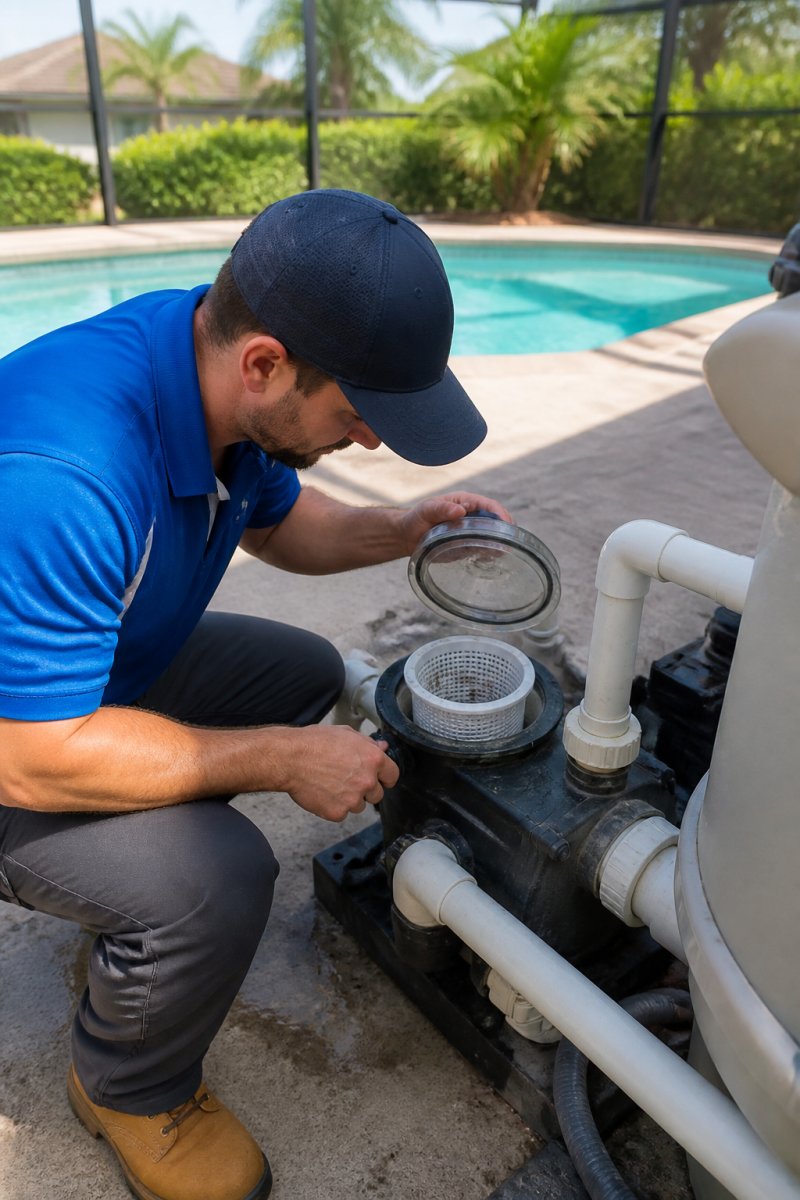
Strainer and Skimmer Baskets
The strainer basket sits inside the pump housing under the clear lid. The skimmer basket sits in the pool deck. Both catch debris before it reaches the impeller.
Valve Position and Water Level
Check every valve between the skimmer and the pump. A valve left half-closed after backwashing starves the pump. The valve position should route full flow from the pool to the pump intake.
How to Prime a Pool Pump When It Loses Suction
Priming fills the pump housing and suction line with water so the pump moves water instead of air. If your pump runs dry with a half-empty strainer basket, it needs priming.
Step-by-Step Priming Procedure
- Shut off the pump at the breaker or timer.
- Close the valves on the suction and discharge lines.
- Remove the strainer basket lid and fill the housing with water from a hose.
- Inspect the lid O-ring for cracks, grit, or flattening.
- Reinstall the lid and hand-tighten it firmly.
- Open the valves fully.
- Turn the pump on and watch the lid for 30 seconds.
You should see water swirl and bubbles purge within seconds. If the basket stays half-full, air is entering the suction line, see the air leak section below.
Lubricating the Pump Lid O-Ring
A dry or damaged O-ring is the most common cause of a pump that won't hold prime. Apply a thin coat of silicone-based lubricant made for pool equipment; petroleum jelly degrades rubber seals. Replace a cracked or flattened ring.
Pool Pump Impeller Clogged Symptoms and How to Clear Them
A clogged impeller produces a specific signature: normal motor sound, normal water level, but weak or pulsing flow at the returns. The pump spins, but debris around the blades blocks the water path.
Signs the Impeller Is Blocked
Watch for these pool pump impeller clogged symptoms:
- Return jets feel weak even after cleaning baskets
- Flow rate drops gradually over days, not suddenly
- The pump runs hot to the touch
- Filter pressure reads low instead of high
- You hear a grinding or rattling tone from the housing
If several of these match, the impeller is the likely culprit.
Safe Removal of Debris From the Impeller
Kill power at the breaker first. Remove the strainer basket and lid, then reach into the housing and feel the impeller at the back; you can often pull out leaves, pine needles, or hair by hand. For stubborn debris, use a small screwdriver or wire to gently work it free.
How to Troubleshoot Pool Pump Air Leak Problems
Air entering the suction side is the top reason a pump won't stay primed. A pool pump air leak shows up as bubbles in the strainer basket that never clear, plus sputtering returns.
Finding the Source of the Leak
Work from the pump backward toward the skimmer. The usual suspects, in order of likelihood:
- The pump lid O-ring or a loose lid
- A cracked or loose union fitting on the suction line
- A bad valve gasket or manifold seal
- A cracked pipe underground, often after a freeze
When the Problem Is Electrical: Capacitors, GFCI, and Safety
If the motor is silent, hums without spinning, or trips a breaker, the fault is electrical. Treat every check as live until you have proven it dead.
Lockout/Tagout for a Residential Pump
A pool pump is usually a 240-volt circuit fed by a dedicated double-pole breaker. The timer or automation relay only switches one leg in many setups, so the motor can still be energized even when the pump appears off. The breaker, not the timer, is your disconnect.
- Flip the double-pole breaker to OFF.
- Apply a lock or a tag to the panel door.
- Test for voltage at the motor's line terminals with a non-contact tester, then confirm with a multimeter set to AC volts across both hot legs and each leg to ground.
- Only after a zero reading do you open the motor's rear cover or the capacitor housing.
Testing and Replacing a Capacitor
A capacitor stores a charge even after power is removed and can deliver a painful shock. Before touching the terminals, discharge it by shorting across the blades with an insulated screwdriver, or use a multimeter with a capacitance setting.
- Disconnect the capacitor leads and note which wire goes to which terminal.
- Set your multimeter to the capacitance (µF) range.
- Compare the reading to the microfarad rating printed on the can. A reading far below the rating, or a reading that drifts, means replace it.
- Match the microfarad rating and the voltage rating exactly. A higher voltage rating is acceptable; a different capacitance is not.
What the Motor Tells You
- Silent, no hum, no breaker trip: power is not reaching the motor. Check the breaker, the timer, the automation relay, and the wiring connections.
- Loud hum, no rotation, breaker holds: likely the capacitor or a seized shaft. Try turning the shaft by hand with power off; if it will not turn, the bearings or the impeller are binding.
- Hums briefly, then trips the breaker: a shorted winding or a grounded motor. This is an electrician or motor-shop job, not a DIY repair.
- Runs, then trips after a few minutes: overheating from a clogged impeller, low water, or a failing winding.
If the motor passes every electrical check but still will not turn the impeller, the problem is mechanical, not electrical, and the next section is where you look.
Filter Pressure and Backwash: The Hidden Flow Killer
A dirty filter restricts flow on the discharge side, backing up pressure and slowing circulation even when the pump is healthy. Check the filter pressure gauge on your multipurpose valve; a reading 8-10 PSI above your clean baseline means it is time to backwash or clean the filter.
Reading the Gauge Correctly
A pressure gauge that reads zero with the pump running is not good news. It usually means the gauge failed, the valve bypasses the filter, or the pump is not moving water. Replace a fogged or stuck gauge; it is your best diagnostic tool on the discharge side.
Backwash, Rinse, and the Valve Positions That Matter
On a multipurpose valve, the positions you will use most are Filter, Backwash, Rinse, Waste, and Recirculate. Two mistakes cause most of the trouble:
- Backwashing and then returning straight to Filter without a Rinse cycle. Rinse for 15-30 seconds after backwash to settle the sand bed and push residual debris to waste. Skipping Rinse sends dirt back into the pool.
- Leaving the valve between detents. Always rotate the handle firmly until it seats in a labeled position. A valve caught between ports can deadhead the pump and damage the impeller.
Variable Speed Pumps: Error Codes and Controller Diagnostics
Common VSP fault patterns and what they mean:
- Priming failure / prime timeout: the controller ran the pump at high speed for its prime window and never detected water. Check water level, basket, lid O-ring, and suction valves first. The pump is telling you it has a suction-side air or blockage problem.
- Overcurrent or overvoltage: the drive is seeing more current than expected. Often a clogged impeller, a binding bearing, or a supply voltage problem. Do not keep resetting it; find the cause.
- Overheat / thermal fault: the motor is running hot. Low water, a clogged impeller, or restricted discharge flow are the usual causes.
- Communication fault: the controller has lost contact with the drive or the automation system. Check the control cable and the automation panel before assuming the pump is bad.
- Low flow / no flow detected: some drives estimate flow from speed and current. A dirty filter, a closed valve, or a partially blocked line will trigger this even when the motor is fine.
If the controller shows no fault, the pump runs at the commanded speed, and the gauge and returns still tell you flow is low, the problem is mechanical or hydraulic, not electronic. Move to the impeller and suction-line checks above.
Frequently Asked Questions
How do you reset a pool pump?
Turn off power at the breaker, wait 30 seconds, then switch it back on. If the pump has a reset button on the motor, press it firmly. For pumps controlled by a timer or automation system, check that the schedule is active and the manual override is off. If the pump trips the GFCI again immediately, stop and call a licensed technician, because repeated tripping points to a wiring or motor fault that needs professional diagnosis.
What are the most common reasons a pool pump loses prime?
The usual culprits are a low water level below the skimmer, a clogged strainer basket, a worn or dry pump lid O-ring, a cracked pump housing, or an air leak on the suction side. A stuck check valve or a partially closed valve can also break prime. Start by checking water level and baskets, then inspect the O-ring and suction plumbing. Most prime loss traces back to one of these simple mechanical issues.
Is it safe to run a pool pump if it isn't circulating water?
No. Running a pump that isn't moving water causes the motor to overheat, which can damage the impeller, seals, and windings. It also stops filtration and chemical distribution, so water quality drops fast. If you see the pump running dry, shut it off at the breaker immediately. Restore water flow and prime before restarting. If the pump ran dry for more than a minute or two, have it inspected for seal damage.
What does it mean when my pool pump is humming but not moving water?
A humming pump that won't circulate usually means the motor is receiving power but the shaft isn't turning. Common causes include a failed capacitor, a seized impeller from debris, or a locked motor bearing. Turn off power and check for debris around the impeller first. If the impeller spins freely by hand and the pump still hums without starting, the capacitor is the likely fault. Capacitor replacement involves stored voltage, so a qualified technician should handle it.


Comments
Post a Comment