How to Choose a Pool Service Company: A Vetting Guide
Table of Contents
- Why Choosing the Right Pool Service Company Matters
- Questions to Ask a Pool Service Company Before Hiring
- Create a Pool Service Checklist for Evaluation
- Comparing Quotes and Understanding Service Frequency
- Review the Pool Service Contract and Guarantees
- Verify Reliability and Check References
- Red Flags to Avoid When Choosing a Pool Service
- Professional vs. DIY Maintenance: Know When to Hire
- Frequently Asked Questions
Last Updated: October 12, 2026
Why Choosing the Right Pool Service Company Matters
The U.S. pool service market is thriving, with over 78,800 businesses serving millions of homeowners pool service market statistics.
Most homeowners either dive into an overwhelming DIY routine or hire the first service that answers the phone. Neither works well.
This guide covers how to choose a pool service company: the questions to ask, what to look for in contracts, and red flags to avoid.
Questions to Ask a Pool Service Company Before Hiring
Before you hire anyone, ask the right questions. These reveal whether a company is professional, experienced, and trustworthy.
Licensing, Insurance, and Credentials
Start with the fundamentals: valid state licensing and insurance. These aren't optional niceties, they're protection for you.
Ask directly: "Are you licensed to provide pool service in this state?" and "What is your insurance coverage?" A legitimate pool service company carries general liability insurance and workers' compensation and provides proof without hesitation.
Ask about certifications too. Many pool professionals hold Certified Pool Operator (CPO) credentials, showing they've passed rigorous exams on water chemistry, safety, and equipment operation.
Experience and Service Scope
Ask how long the company has been in business and how many pools they service. A company around 10+ years has weathered market changes and customer demands.
Confirm they service your specific pool type: in-ground or above-ground, saltwater or chlorine, vinyl, concrete, or fiberglass.
Finally, ask what services they offer: routine maintenance, equipment repair, seasonal opening and closing, and upgrades? EcoClean Pool Services, Llc. offers comprehensive weekly pool maintenance programs, filter cleaning, pool equipment repairs, and advanced UV/Ozone water treatment systems.
Create a Pool Service Checklist for Evaluation
Use the table below to track each company, then follow the verification steps underneath so every box is backed by evidence, not a sales pitch.
| Evaluation Criteria | What to Check | How to Verify | Status |
|---|---|---|---|
| Licensing and Insurance | Valid state license + proof of liability and workers' comp insurance | Ask for license number and a certificate of insurance; call the state licensing board and the insurer to confirm active status | ☐ Verified |
| Experience | Years in business, number of pools serviced, pool type expertise | Ask for the number of residential pools on the route and the mix of in-ground, above-ground, saltwater, and vinyl pools | ☐ Confirmed |
| Service Scope | Routine maintenance, repairs, equipment upgrades, water treatment options | Request a written service description and compare it line by line to your pool's needs | ☐ Matches needs |
| References | At least 3 recent customer references | Call each reference and ask how long they have used the company and what happened when something went wrong | ☐ Obtained |
| Written Estimate | Detailed breakdown of services and costs | Compare the line items across companies; flag any service that appears in one estimate but not another | ☐ Received |
| Communication | Response time, availability, ease of scheduling | Send an email or text with a routine question before hiring and note how long a reply takes | ☐ Tested |
| Equipment Knowledge | Familiarity with your specific pump, filter, heater, automation system | Ask the technician to identify your equipment by brand and model during a walkthrough | ☐ Confirmed |
| Warranty or Guarantee | Written guarantee on work performed | Ask what is covered, for how long, and whether it is prorated or limited to labor only | ☐ In writing |
How to Verify Licensing and Insurance
Do not accept a photocopy at face value. Ask for the license number and insurance carrier name, then call the state board and the carrier's agent to confirm the policy is active. For workers' compensation, ask for the policy number and coverage limit. If a company cannot produce these documents promptly, treat that as a disqualifier.
How to Check References and Complaint History
Ask for three references from customers whose pools are similar to yours in size and type. When you call, go beyond "Are you happy?" Ask how long they've used the company, whether visits were ever missed, how questioned repair recommendations were handled, and whether the price changed after the first month. Then check complaint history through your state's consumer protection office, the Better Business Bureau, and local review platforms.
How to Test Communication Before You Commit
Reliability starts before the first visit. Send a routine question by email or text, such as how they handle a week with heavy rain or whether they test for phosphates. Note the response time and whether the answer is specific. A company that replies within a few hours with a clear process is more likely to communicate well after you sign.
Comparing Quotes and Understanding Service Frequency
Never hire based on price alone. Compare what you're actually getting.
What to Look for in a Written Estimate
A professional pool service company provides a written estimate before work begins, detailing:
- Specific services included: "Weekly skimming, brushing, vacuuming, filter inspection, and chemical testing" beats "general maintenance."
- Service frequency: Weekly, bi-weekly, or monthly? How many hours per visit?
- Chemical balancing: Will they test and adjust pH, alkalinity, and sanitizer levels?
- Equipment inspection: Do they check pump operation, filter pressure, and heater function?
- Seasonal services: Opening, closing, equipment winterization?
Compare three estimates side by side. One company might charge less but skip filter cleaning; another includes upgrades you don't need yet. The option that matches your actual needs is usually the best value.
Weekly Service vs. On-Demand Maintenance
Weekly pool service is the gold standard for most residential pools. A technician visits once per week, tests water chemistry, cleans debris, and inspects equipment, preventing problems before they become expensive.
On-demand maintenance means you call when something goes wrong. It's cheaper upfront but risky. Water chemistry drifts. Equipment deteriorates. A single repair often costs more than a month of preventive weekly service.
Review the Pool Service Contract and Guarantees
A contract is only as good as the details it spells out. Before you sign, compare it against the written estimate to confirm that what was promised verbally appears in writing.
How to Compare Quotes Like-for-Like
Quotes are rarely apples to apples. One company may include filter cleaning while another charges it as an add-on. To normalize them, build a grid with the same rows for every company:
- Base service: What is included in the recurring visit (skimming, brushing, vacuuming, water testing, chemical balancing)?
- Frequency and duration: How many visits per month, and how long is each visit expected to take?
- Chemicals: Are chemicals included or billed separately? If separate, how are they priced and documented?
- Equipment checks: Which equipment is inspected each visit (pump, filter, heater, automation)?
- Seasonal services: Are opening, closing, and winterization included or quoted separately?
Once the grid is filled, compare total scope, not just the headline number. A lower quote that excludes chemicals or filter cleaning may cost more over a season than a higher quote that includes them.
Contract Elements That Protect You
Look for these clauses and ask for clarification on any that are vague or missing:
- Service schedule: Days and times of visits, plus how schedule changes are communicated.
- Cancellation terms: How much notice is required, and whether there are penalties or minimum terms.
- Liability limits: What happens if the technician damages your pool, equipment, or property, and whether the company carries insurance to cover it.
- Warranty: What work is guaranteed, for how long, and whether the guarantee covers labor, parts, or both.
- Payment terms: Billing cycle, accepted payment methods, and any late fees.
- Service guarantees: Response time for emergency calls and whether a missed visit is credited or rescheduled.
Questions to Ask Before Signing
- Can you show me a sample contract with the same terms I would receive?
- What happens if a visit is missed due to weather or staffing?
- Are chemicals included, and how do you document what was added?
- If you recommend a repair, do I get a written estimate before work begins?
- How do you handle a dispute if I disagree with a charge?
A good pool service contract protects both you and the company, setting clear expectations and telling you how disputes are resolved. Never sign one with vague terms or blank sections.
Verify Reliability and Check References
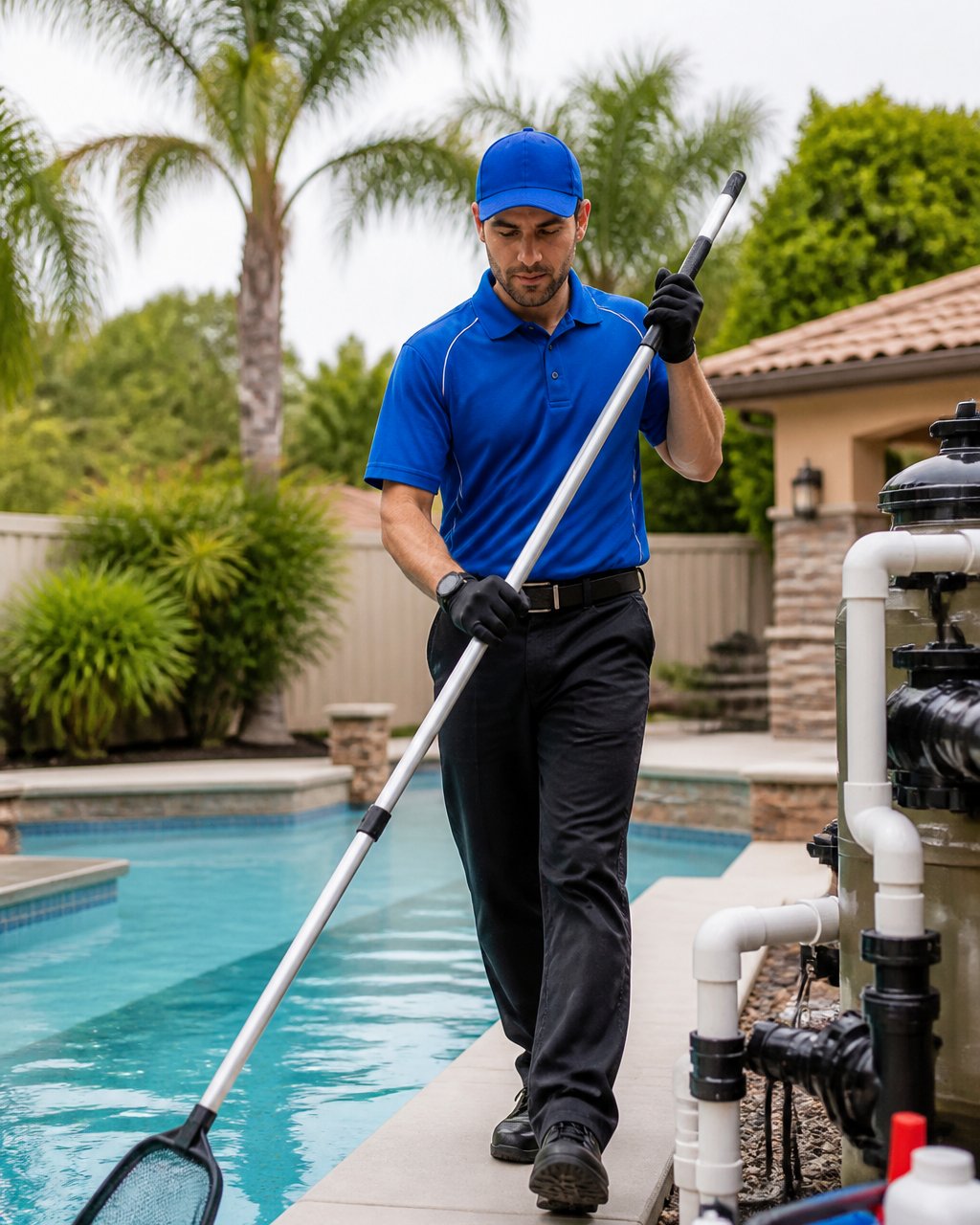
Reliability separates great pool service companies from mediocre ones. You need someone who shows up on schedule, does quality work, and communicates clearly.
Ask for at least three recent customer references and call them.
Check online reviews too.
Industry recognition also signals reliability.
Red Flags to Avoid When Choosing a Pool Service
Watch for these warning signs. They often predict poor service:
- No written estimate: If they quote over the phone without seeing your pool, they're guessing.
- No licensing or insurance: This is non-negotiable. You're liable if they're injured on your property.
- Pressure to sign long-term contracts: Reputable companies stand behind their work. They don't lock you in for years.
- No references: Any company can provide three happy customers. If they won't, that's suspicious.
- Poor communication: If they're hard to reach before hiring, they'll be worse after.
- Vague service descriptions: "We'll maintain your pool" isn't specific enough. You need to know exactly what they'll do.
Trust your instincts. If something feels off, keep looking.
Professional vs. DIY Maintenance: Know When to Hire
Some pool owners try DIY maintenance. It saves money initially, but it's demanding and risky.
Weekly DIY maintenance means testing water chemistry twice a week, brushing walls, vacuuming, skimming debris, and cleaning the filter, plus understanding pH, alkalinity, chlorine, and salt levels.
Equipment problems are trickier still.
Professional pool service handles all this. They bring expertise, equipment, and accountability.
Hire professional service if:
- You have limited time or technical interest
- Your pool has complex equipment or advanced systems like UV/Ozone treatment
- You want consistent, reliable water quality
- You want someone to catch equipment problems early
DIY maintenance makes sense only if you're willing to learn and commit several hours per week.
Frequently Asked Questions
What questions should I ask a pool service company before hiring?
Ask about licensing, insurance coverage, years of experience, service area, and what's included in their pool maintenance visits. Request references from current customers, inquire about response times for equipment repairs, and confirm they can handle your specific pool type (vinyl, in-ground, saltwater). Ask about their water testing and chemical balancing procedures, and whether they offer written estimates and service agreements. Finally, ask what happens if something goes wrong during a service visit.
How do I compare pool cleaning companies fairly?
Request written estimates from multiple pool service providers that detail what's included in their weekly pool service, frequency of visits, and any additional fees. Compare their credentials, licensing, and insurance coverage. Check customer reviews and ask for references you can contact directly. Evaluate their communication style and responsiveness to your questions. Review their pool service contract terms, cancellation policies, and guarantees. Don't choose based solely on price; consider reliability, experience, and the scope of services offered.
What should a pool service visit include?
A comprehensive pool maintenance visit should include debris removal through skimming and vacuuming, brushing pool walls and floor, cleaning or inspecting the filter, testing water chemistry, balancing sanitizer levels and pH, checking equipment for proper operation, and documenting the work performed. Some providers also offer equipment inspections, filter cleaning, and more advanced services like UV or ozone water treatment system maintenance. Clarify exactly what's included in your weekly pool service agreement to avoid surprises.
How can I tell if a pool service company is reliable?
Check customer reviews and ratings on independent platforms, and ask for references from current clients. Verify they show up on schedule and communicate proactively about any issues. A reliable pool service company will provide written service agreements, respond quickly to inquiries, and stand behind their work with guarantees. Ask how they handle missed appointments or service failures. Companies with consistent customer testimonials, established track records, and professional credentials are more likely to deliver dependable service.
Choosing a pool service company doesn't have to be stressful. Ask the right questions, verify credentials, compare written estimates, and check references. EcoClean Pool Services, Llc. combines experienced technicians, comprehensive weekly pool maintenance programs, and advanced water treatment options like UV/Ozone systems to keep your pool safe and crystal clear. Get started with a consultation today and enjoy a worry-free backyard oasis.


Comments
Post a Comment