How to Maintain Green Pool Water: Fix & Prevent Algae
Table of Contents
- Why Pool Water Turns Green and How to Diagnose It
- Step-by-Step: How to Clear Green Pool Water Fast
- How to Shock a Pool Without Making It Worse
- Pool Water Chemistry Balancing Guide for Green Water
- How to Clean Pool Filter After Algae Treatment
- Troubleshooting When Green Water Won't Clear
- Preventing Green Pool Water: Weekly Maintenance Habits
- Conclusion: When to Call a Pool Professional
- Frequently Asked Questions
Last Updated: October 4, 2026
Why Pool Water Turns Green and How to Diagnose It
Green pool water is almost always an algae bloom, and it happens when chlorine can't keep up with what's growing in your pool. Learning how to maintain green pool water starts with one shift in thinking: find out why the chlorine failed before you pour in more chemicals.
That's the approach we take at EcoClean Pool Services. Chemical treatment alone rarely fixes a green pool.
The Real Cause: Algae Blooms and Poor Circulation
Algae is a plant. It needs sunlight, warmth, and still water to grow. When your pump runs too few hours or your filter is clogged, water stops moving, and algae takes over fast.
Chlorine kills algae only when it stays at the right level. According to HTH Pools' sanitization standards, you need 1-4 ppm of chlorine to keep water clear. Let that number drop, and algae wins.
Quick Diagnostic Checklist Before You Treat
Run through this list before buying anything:
- Test free chlorine and pH with test strips
- Check pump pressure gauge against its normal reading
- Look inside the skimmer basket for debris
- Confirm the pump runs 8-12 hours daily
- Note the water color: cloudy green vs. bright green vs. dark green
Hasa's circulation best practices recommend 8-12 hours of daily pump run time during swim season. If your pump runs less, that's your first fix.
Step-by-Step: How to Clear Green Pool Water Fast
Clearing a green pool takes 2-4 days of consistent work. The order matters more than the products you buy. Skip a step and you'll be back to square one.
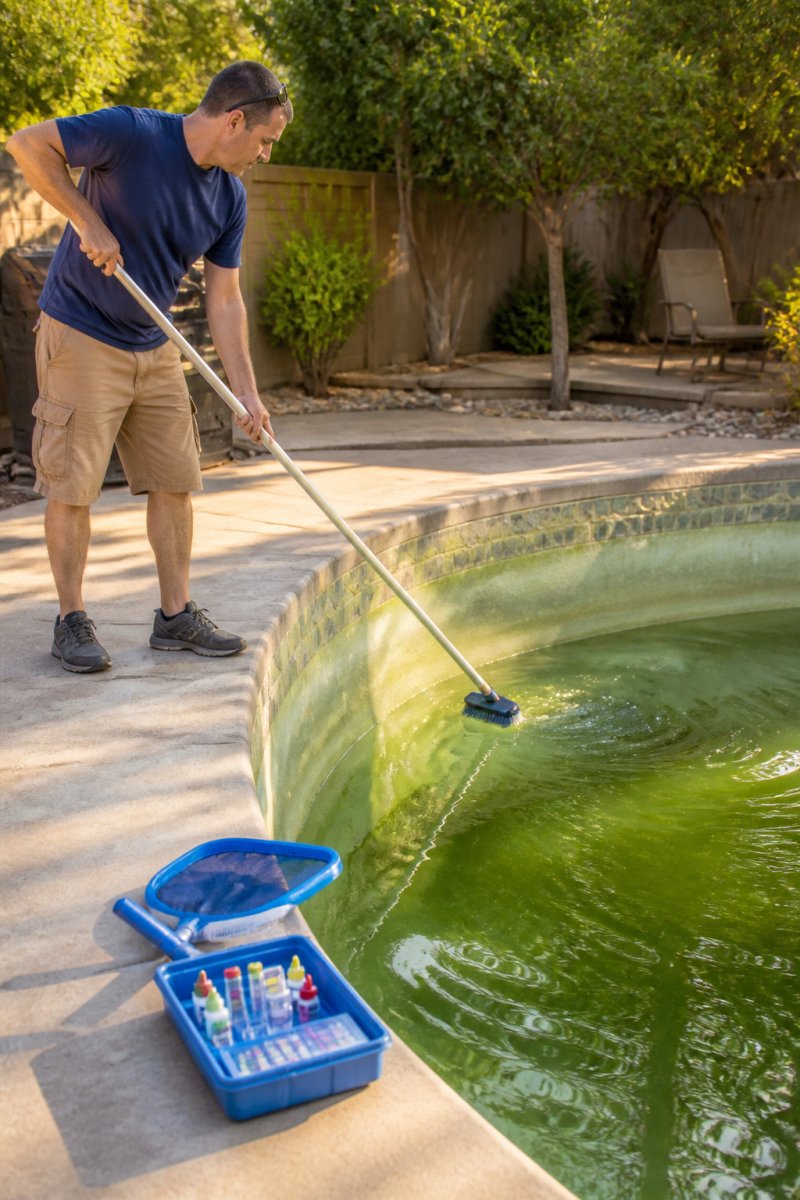
Step 1: Remove Debris and Brush All Surfaces
Start by skimming leaves and debris off the surface. Empty the skimmer basket. Then brush the walls, floor, and steps.
Why brush? Algae clings to surfaces and builds a protective layer. Brushing breaks that layer so chlorine can reach it. Pay extra attention to corners, ladders, and light fixtures.
Step 2: Run the Pump and Filter Continuously
Turn the pump on and leave it running 24/7 until the water clears. Check the pressure gauge every few hours. When pressure rises 8-10 psi above the clean reading, it's time to backwash or clean the filter.
Step 3: Shock, Test, and Repeat Until Clear
Now you can shock the pool. Test your levels, add shock, and run the filter overnight. Test again in the morning. If chlorine dropped to zero, the algae consumed it. Shock again.
Repeat this cycle daily. Most pools clear in 2-4 days. If yours doesn't, jump to the troubleshooting section below.
How to Shock a Pool Without Making It Worse
Shocking a pool means raising free chlorine far above normal levels to kill algae, bacteria, and other organics in one pass. Get the dose wrong and you either waste chemicals or damage your pool surface. The dose is not a guess, it is math based on your cyanuric acid (CYA) level.
The Dose Depends on Your CYA, Not the Label
Standard shock dosing keeps chlorine at 1-4 ppm. That is a maintenance dose, not an algae kill. To actually kill a bloom, you need to reach shock level, which is roughly 40% of your CYA reading. The industry reference for this is the chlorine/CYA chart published by Trouble Free Pool, which most pool techs treat as the working standard.
| CYA (ppm) | Minimum FC | Shock / SLAM Level |
|---|---|---|
| 30 | 2 | 12 |
| 40 | 3 | 16 |
| 50 | 4 | 20 |
| 60 | 5 | 24 |
| 70 | 5 | 28 |
| 80 | 6 | 31 |
If your CYA is 80 and you shock to 10 ppm, you have not shocked anything. You have fed the algae. This is the single most common reason a shock "doesn't work."
Step-by-Step Shock Process
- Test pH first. Adjust it to 7.2-7.6 before shocking. Chlorine loses most of its killing power above pH 7.8.
- Test CYA. Look up your shock level in the chart above.
- Calculate your pool volume in gallons. Length x width x average depth x 7.5 for a rectangle.
- Add the shock dose per the label to hit your target FC, not the maintenance dose.
- Run the pump 24 hours after shocking.
- Retest FC the next morning. If it dropped more than 1 ppm overnight, organics are still consuming it. Shock again to the same target.
Use calcium hypochlorite for a fast kill. Never mix it with other chemicals. Add it to water, not water to it.
Pool Water Chemistry Balancing Guide for Green Water
Balanced water is what keeps your pool clear after the algae dies. This pool water chemistry balancing guide covers the four numbers that matter most.
| Chemical | Target Range | Why It Matters |
|---|---|---|
| Free chlorine | 1-4 ppm | Kills algae and bacteria |
| pH | 7.2-7.6 | Controls how well chlorine works |
| Total alkalinity | 80-120 ppm | Keeps pH from swinging |
| Cyanuric acid | 30-50 ppm | Shields chlorine from sunlight |
Chlorine, pH, Alkalinity, and Cyanuric Acid Targets
Chlorine does the killing. pH decides how well it kills. When pH climbs above 7.8, chlorine loses much of its power, even at a good ppm reading.
Alkalinity acts as a buffer. Low alkalinity makes pH bounce around. High alkalinity makes pH hard to lower.
Cyanuric acid is your stabilizer. Too little and the sun eats your chlorine. Too much, often from chlorine tablets, and chlorine stops working.
MDPI's Water journal research on pool water quality confirms that continuous renewal and purification are required to keep pool water microbiologically safe and visually clear.
How to Clean Pool Filter After Algae Treatment
Your filter is full of dead algae, and it will keep recycling green water until you clean it. This step is where most DIY treatments quietly fail, not because people skip it, but because they clean the filter once and assume it is done.
Sand and DE Filters: Backwash, Then Backwash Again
Start with a backwash. Run it until the sight glass clears, then run it another 30 seconds. Dead algae is fine enough that a sight glass can look clear while the sand bed is still loaded.
After backwashing, note the pressure gauge reading with the pump running clean. That is your baseline. During an active algae recovery, expect pressure to climb 8-10 psi above baseline within 24-48 hours.
For DE filters, backwash and then recharge with fresh DE powder per the label. Skipping the recharge leaves the grids unprotected and lets DE pass into the pool.
Cartridge Filters: Hose, Soak, Repeat
Pull the cartridge and hose it down with a strong spray, working top to bottom between each pleat. A cartridge that looks clean can still be coated in algae residue that rinses off as a fine green film.
Then soak the cartridge in a filter cleaner for a few hours. Rinse well and let it dry before reinstalling. Expect to clean your filter two or three times during a full algae recovery, not once.
How to Know the Filter Is Actually Clean
Check the pump pressure after every clean. A filter that still reads high after cleaning may need replacement. Two other signs the filter is done:
- The cartridge pleats are matted or torn
- The sand bed has channeled (water finds a path through instead of filtering)
- DE grids have tears that let DE into the pool
Troubleshooting When Green Water Won't Clear
If your pool stays green after a week of treatment, stop adding chemicals. Something mechanical is broken.
Work through these causes:
- Dead pump or weak flow: No circulation means no distribution of chlorine.
- Clogged or worn filter: Pressure readings tell you this fast.
- High cyanuric acid: Above 50 ppm, chlorine is locked up. Partially drain and refill.
- High phosphates: Phosphates feed algae. Use a phosphate remover.
- Low chlorine at night: Algae grows in the dark. Test before bed.
AV Pool Pros' algae remediation case notes describe recurring algae that only stopped after servicing the filtration system and correcting chemical imbalances, not after more shock.
Preventing Green Pool Water: Weekly Maintenance Habits
Prevention costs far less time than recovery. A 15-minute weekly routine keeps algae from ever getting a foothold.
- Test chlorine and pH twice a week
- Brush walls and steps weekly
- Empty skimmer and pump baskets weekly
- Backwash when pressure rises 8-10 psi
- Run the pump 8-12 hours daily
- Shock every 1-2 weeks in summer
One more number to track: total dissolved solids. In-ground pools typically need a full drain and refill every 3-5 years to prevent chemical byproduct buildup, based on Epic Swimming Pools' maintenance guidelines. When TDS climbs, chlorine stops working no matter how much you add.
Conclusion: When to Call a Pool Professional
Some green pools need more than chemicals. If your pump is failing, your filter is shot, or your cyanuric acid is locked above 50 ppm, DIY treatment will keep costing you money with no clear water to show for it.
EcoClean Pool Services handles this exact problem. Our certified technicians diagnose equipment faults, clean and service filters, balance chemicals, and install UV and ozone water treatment systems that reduce chlorine demand.
Get started with EcoClean Pool Services and get your pool back to clear, safe, and ready to swim.
Frequently Asked Questions
What is the fastest way to clear up a green pool?
The fastest method is a full green-to-clean process: remove debris, brush all surfaces, run the pump and filter 24 hours a day, then shock the pool with the correct dose for your gallons. Keep chlorine at 1-4 ppm and re-test every few hours. One case study from Simplified Pools recovered full water clarity within 3 days using this approach. If the water stays green after 48 hours, check your filter and circulation before adding more chemicals.
How long does it take for green pool water to clear up?
Most green pools clear within 3 to 5 days when you brush, shock, and run filtration continuously. The exact time depends on how green the water is, your filter condition, and whether phosphate or stabilizer levels are interfering. If your pool has not improved after 5 days of consistent treatment, the issue is usually mechanical (a clogged filter or weak pump), not chemical. That is when a professional diagnostic visit saves both time and money.
Can a green pool be saved, or does it need to be drained?
A green pool can almost always be saved without draining. In-ground pools only need a full drain and refill every 3 to 5 years to prevent chemical byproduct buildup. For algae, shock treatment combined with proper filtration clears the water. Draining is a last resort for extreme total dissolved solids or severe staining. Always verify your pump and filter are working first, because chemical shock alone will fail if circulation is poor.
How do I keep my pool water from turning green in the first place?
Keep chlorine at 1-4 ppm, pH between 7.2 and 7.8, and run your pump 8-12 hours daily during swim season. Test water twice a week with strips or a liquid kit, empty the skimmer basket, and brush walls weekly. Add one sanitizing tablet per 10,000 gallons as a baseline. Many homeowners find that a weekly maintenance program handles these steps consistently, which is what actually prevents algae from returning.


Comments
Post a Comment