Is Pool Equipment Repair Worth It? A 2026 Guide
Table of Contents
- When Pool Equipment Repair Makes Financial Sense
- Pool Equipment Repair vs Replacement: The 50% Rule
- Signs Your Pool Pump Is Failing
- Pool Pump Not Circulating Water: Troubleshooting Steps
- Pool Equipment Maintenance: The Cost of Prevention
- DIY Repairs vs Professional Service: What Affects Your Decision
- Energy Efficiency and Long-Term Equipment ROI
- Frequently Asked Questions
Last Updated: October 7, 2026
When Pool Equipment Repair Makes Financial Sense
Is pool equipment repair worth it? It depends on one critical factor: repair cost relative to replacement. When a pump, filter, or heater fails, sometimes repair makes sense, sometimes replacement saves money in the long run.
At EcoClean Pool Services, we've helped hundreds of homeowners navigate this decision. A failing pump doesn't automatically mean you need a new one, but a pump that costs more to repair than to replace almost certainly does.
The real challenge is understanding remaining service life, the likelihood of future failures, and how those affect total cost of ownership over the next five to ten years. This guide covers the financial and practical considerations that should drive your decision.
Pool Equipment Repair vs Replacement: The 50% Rule
The 50% rule is the most widely cited shortcut: if a repair quote exceeds half the price of a comparable new unit, replacement usually wins. It's a useful starting point, but a better approach layers four factors on top of the raw percentage.
Factor 1: Remaining Service Life
Every piece of pool equipment has an expected service life: roughly 8 to 12 years for a single- or two-speed pump, 10 to 15 years for a cartridge or sand filter tank, and 5 to 10 years for a gas heater. These ranges vary with water chemistry, run time, and installation quality, but they give you a denominator for the decision.
If a pump is in year 9 of a 10-year life and the repair is 40% of replacement cost, the 50% rule says repair. The remaining-life math says replace, you're buying a short runway and likely another repair within two seasons.
Factor 2: Repair Frequency, Not Just Repair Size
One repair on a 6-year-old pump is normal; three repairs in 18 months is a pattern. If you've spent more than roughly 30% of a replacement unit's price on repairs in the last 24 months, the equipment is telling you something the 50% rule can't.
Factor 3: Warranty Status
A unit still under a manufacturer's warranty changes the math entirely: a covered repair may cost only a diagnostic or trip charge, making repair the obvious call. Once the warranty expires, the calculus flips toward replacement because you absorb 100% of future failure risk.
Factor 4: Efficiency Delta
If the failing unit is a single-speed pump and the replacement is a variable-speed model, energy savings over the new unit's life often exceed the price gap between repair and replacement, a factor that belongs in the same decision.
A Simple Scoring Framework
Score each factor from 1 (favors repair) to 3 (favors replacement):
| Factor | Repair (1) | Neutral (2) | Replace (3) |
|---|---|---|---|
| Repair cost vs. new unit | Under 30% | 30-50% | Over 50% |
| Equipment age vs. expected life | Under 50% of life used | 50-75% used | Over 75% used |
| Repairs in last 24 months | 0-1 | 2 | 3+ |
| Warranty status | Active | Recently expired | Long expired |
| Efficiency gap vs. current models | Minimal | Moderate | Large |
Total the scores. A total of 5-8 leans repair. 9-12 is a judgment call that depends on your budget and tolerance for risk. 13-15 strongly favors replacement.
When the Rule Doesn't Apply
Some failures are catastrophic regardless of cost ratio. A cracked filter tank, a heater with a compromised heat exchanger, or a pump motor with a shorted winding are replacement events, not repair candidates. If the equipment is discontinued and parts are on backorder, repair is impractical even at a low quoted price.
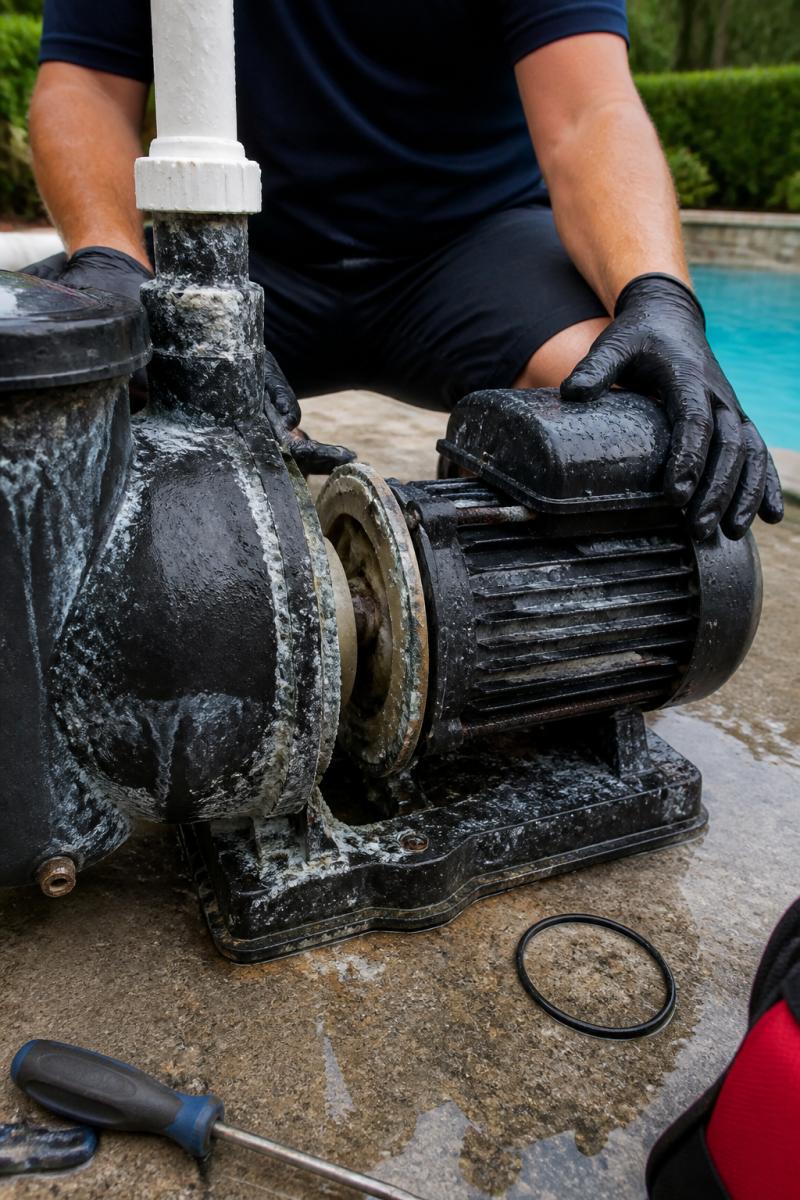
Signs Your Pool Pump Is Failing
Your pump is the heart of your circulation system: without it, water doesn't move, chemicals don't distribute, and algae takes over. Recognizing early warning signs saves you from emergency repairs and gives you time to plan.
Common Symptoms to Watch
Unusual noises are often the first sign.
Reduced water flow means weaker return jets or a skimmer that isn't pulling debris effectively.
Leaking water around the pump housing indicates seal failure. A small drip accelerates seal deterioration and can lead to motor damage if water enters the electrical components.
Tripping the breaker repeatedly suggests an electrical fault, the motor is drawing too much current or there's a short in the wiring. This is a safety issue requiring immediate professional attention.
Vibration means internal components are out of balance or bearings are failing. You might feel it through the equipment pad or notice the pump shifting slightly.
Pool Pump Not Circulating Water: Troubleshooting Steps
When your pump runs but water isn't flowing, check these common culprits before assuming the pump itself has failed.
Check the skimmer basket and pump strainer basket. A clogged basket blocks flow before it reaches the pump.
Inspect the filter. A dirty filter restricts flow significantly; if your pressure gauge reads higher than normal, it needs cleaning.
Look for air leaks in the suction line. Air entering before the pump causes prime loss and stops circulation.
If water still isn't flowing after checking these items, the pump itself likely has an internal problem.
Pool Equipment Maintenance: The Cost of Prevention
Prevention is genuinely cheaper than emergency repair: a maintenance program costs far less than replacing a failed pump or fixing water damage from a leaking filter.
Regular maintenance includes weekly chemical balancing, monthly filter cleaning or backwashing, and quarterly inspections of pump seals, filter housing, and heater connections, catching small problems before they become expensive.
Clogged filters force your pump to work harder, generating heat and accelerating bearing wear.
A professional inspection twice per year identifies worn seals, corroded connections, and failing bearings while they're still fixable. Catching a seal leak early costs far less than replacing a motor after water damage.
DIY Repairs vs Professional Service: What Affects Your Decision
Some pool repairs are within reach of a handy homeowner; others require specialized tools, training, and diagnostic equipment only professionals have.
DIY-friendly repairs include replacing a pump strainer basket, cleaning filter media, rebalancing water chemistry, and tightening loose plumbing connections, low-risk tasks a homeowner can learn in an afternoon.
Professional-only repairs include replacing pump seals, rewiring a motor, rebuilding a multiport valve, or diagnosing electrical faults. These require specific tools and training.
The real consideration is warranty.
For complex repairs, professional service is the safer choice financially and practically. For routine maintenance and simple fixes, DIY saves money and builds your understanding of your system.
Energy Efficiency and Long-Term Equipment ROI
Most articles wave at "energy savings" without doing the math. Here's the mechanism and framework so you can run your own numbers.
Why Variable-Speed Pumps Change the Equation
A single-speed pump runs at one RPM whenever it's on; a variable-speed pump lets you dial RPM down and run longer. Because pump power draw scales roughly with the cube of speed, cutting RPM in half cuts power draw to roughly one-eighth, while still moving enough water to turn the pool over once or twice a day.
That's the entire efficiency story. It's also why a variable-speed pump can pay back its price premium in a few seasons in most climates, and why repairing a failing single-speed pump instead of upgrading can lock you into years of higher electric bills.
How to Estimate Your Own Payback
You need four inputs:
- Your pump's wattage. Check the motor nameplate or the owner's manual. Single-speed pumps commonly draw in the 1,500-2,500 watt range; variable-speed pumps at typical settings often run in the 200-800 watt range.
- Daily run hours. Most pools need 6-10 hours of circulation in summer, less in winter.
- Your electric rate. It's on your utility bill, in dollars per kilowatt-hour.
- Days per year you run the pump. Most owners run year-round in warm climates and seasonally elsewhere.
Multiply wattage × hours × days ÷ 1,000 for annual kilowatt-hours, then multiply by your rate. Do this for your current pump and the replacement you're considering; the difference is your annual savings. Divide the new unit's price premium by that savings for your payback period in years.
The ROI Comparison the 50% Rule Misses
Suppose you're choosing between repairing an aging single-speed pump and buying a new variable-speed unit:
- Repair path: You pay the repair cost now, then keep paying the old pump's higher electric bill for every year it survives. You also carry the risk of another failure.
- Replace path: You pay more upfront, then pay a lower electric bill for the new unit's expected life, often 10+ years.
The right comparison isn't repair cost vs. replacement cost. It's (repair cost + future electric bills on the old unit + expected future repairs) vs. (replacement cost + future electric bills on the new unit). Run both over 5- and 10-year horizons, the replace path often wins on total cost of ownership even when the repair quote looks cheaper on day one.
Other Efficiency Levers
- Filter media condition. A clogged cartridge or a sand filter overdue for a media change raises system pressure and pump energy draw. Cleaning and replacing media on schedule is free efficiency.
- Plumbing and fittings. Undersized or partially blocked return lines force the pump to work harder. A professional inspection can spot restrictions you can't see.
- Heater efficiency. Older gas heaters often run at lower thermal efficiency than current models. If your heater is a frequent repair candidate, factor that gap into the replace-vs-repair call.
- Run-time scheduling. Shifting run hours to off-peak electric windows (where your utility offers them) reduces cost with zero capital outlay.
Warranty and DIY: The Hidden ROI Killer
One factor competitors ignore: many manufacturers void the warranty if repairs are performed by non-certified technicians or with non-OEM parts. If warrantied equipment fails during a DIY repair, you don't just lose the repair, you lose coverage on the entire unit, wiping out any efficiency-driven ROI in a single incident.
Before any DIY repair on warrantied equipment, check the terms. If they require certified service, the "cheaper" DIY path isn't cheaper at all.
Frequently Asked Questions
Is it better to repair or replace a pool pump?
The decision depends on repair cost versus replacement value. A general rule: if repair costs exceed 50% of a new unit's price, replacement often makes more sense financially and may be faster. Also consider the equipment's age, pumps nearing the end of their service life are better replaced. A professional inspection can help you weigh both options for your specific situation.
What are the most common pool equipment repair issues?
Clogged filters, leaking valves, pump motor failure, and pressure gauge problems are frequent culprits. Water chemistry imbalances accelerate component wear and tear, leading to unexpected breakdowns. Regular preventative maintenance, including filter cleaning and water chemistry balance monitoring, reduces emergency repairs. Professional system diagnostics can identify issues before they become costly.
How long does pool equipment typically last?
Most pool pumps last 8-12 years with proper maintenance; filters typically need replacement every 5-7 years. Heaters and other components vary based on usage and water quality. Equipment lifespan depends heavily on consistent preventative maintenance and operational efficiency. Upgrading to energy-efficient models may offer better long-term ROI even if your current equipment still functions.
Can I troubleshoot pool equipment myself, or do I need a professional?
Simple troubleshooting, checking pressure gauges, cleaning debris, and verifying pump operation, is manageable for homeowners. However, electrical safety, plumbing integrity, and complex system diagnostics require professional expertise. DIY repairs without proper knowledge can void warranties and create safety hazards. A professional inspection costs less than a major repair mistake and ensures your equipment operates safely and efficiently.


Comments
Post a Comment