Swimming Pool Equipment Repair Services: What to Know
Table of Contents
- What Swimming Pool Equipment Repair Services Actually Handle
- Pool Pump Not Circulating Water: Common Causes and Fixes
- Pool Filter Repair: Symptoms, Diagnostics, and Solutions
- Pool Pump Repair or Replacement: How to Decide
- Pool Equipment Maintenance Checklist for Every Season
- How to Choose a Swimming Pool Equipment Repair Service
- Frequently Asked Questions
Last Updated: October 13, 2026
What Swimming Pool Equipment Repair Services Actually Handle
The U.S. pool cleaning services market hit $8.8 billion in 2025, growing at a steady 2.9% annually, according to IBISWorld's pool services market analysis. At EcoClean Pool Services, we handle swimming pool equipment repair services for homeowners across Katy and the surrounding areas, from routine pump issues to full system diagnostics.
Pool equipment repair is the diagnosis and correction of mechanical failures in a pool's circulation, filtration, and heating systems. It covers pumps, filters, heaters, valves, and the plumbing that connects them. Most repairs fall into three categories: worn parts, electrical faults, and blockages.
Equipment Types: Pumps, Filters, Heaters, and More
The equipment we service most often breaks down into a few core systems:
- Pumps move water through the entire system. When a pump fails, circulation stops and water quality drops within days.
- Filters trap debris and keep water clear. Cartridge, sand, and DE filters each have different failure patterns.
- Heaters warm the water for extended swim seasons. Ignition and flow problems are the most common issues.
Each system interacts with the others. A clogged filter can make a healthy pump overheat. A failing heater often traces back to poor flow, not the heater itself.
When to Call a Professional vs. DIY
DIY makes sense for surface-level tasks: emptying skimmer baskets, rinsing cartridge filters, and checking water levels. Beyond that, the risk climbs fast.
Call a professional when you see electrical faults, persistent pressure drops, water leaks near equipment pads, or a pump that hums without moving water. These symptoms point to problems that get worse, and more expensive, with delay.
Pool Pump Not Circulating Water: Common Causes and Fixes
When a pool pump stops circulating water, the cause is usually one of five things: a clogged strainer basket, a blocked impeller, a failing capacitor, a worn motor, or air entering the suction line.
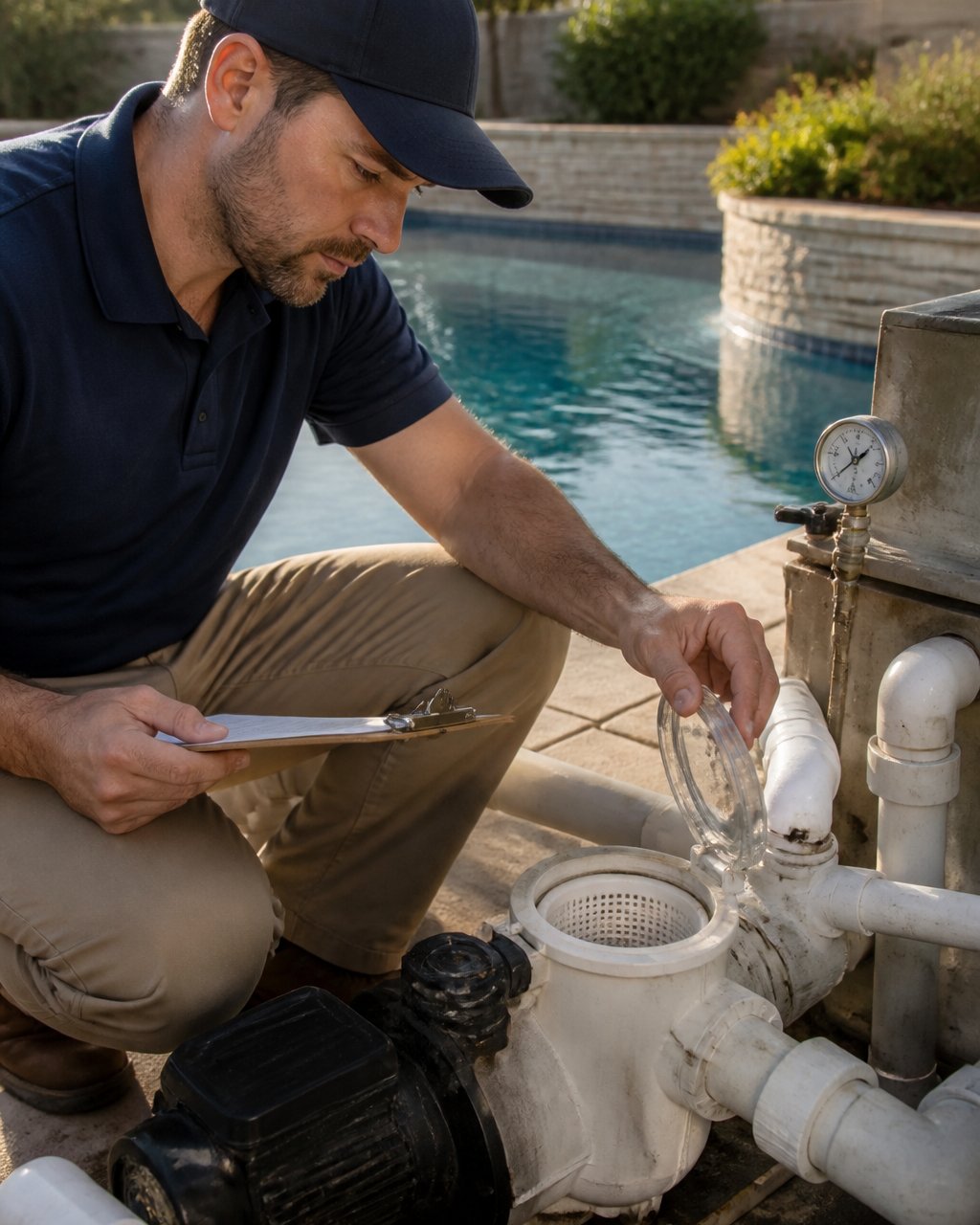
Here's how we work through the diagnosis, in order:
- Check the strainer basket. Debris here is the most common cause of weak flow. Empty it and restart the pump.
- Listen to the motor. A humming motor that won't spin usually means a failed capacitor or a seized bearing.
- Check the pressure gauge. High pressure points to a clogged filter. Low pressure points to a suction-side air leak.
- Inspect the impeller. Debris wrapped around the impeller cuts flow without tripping any alarm.
- Check for air bubbles. Bubbles in the pump basket mean the system is pulling air from a cracked fitting or a low water level.
If the pump runs but flow stays weak after these checks, the motor itself is likely worn. That's a repair-or-replace decision, which we cover below.
Pool Filter Repair: Symptoms, Diagnostics, and Solutions
Pool filter repair starts with one question: is the filter failing, or is it doing its job too well? A filter that clogs quickly is working, not broken.
The symptoms split cleanly:
| Symptom | Likely Cause | Typical Fix |
|---|---|---|
| Pressure 8-10 PSI above normal | Filter media loaded with debris | Clean or backwash the filter |
| Pressure below normal | Bypass or torn media | Inspect grids, cartridges, or laterals |
| Cloudy water after cleaning | Damaged filter element | Replace the cartridge or grid |
| DE powder returning to pool | Torn grid or broken manifold | Replace damaged grids |
| Sand in the pool | Broken lateral in sand filter | Replace the lateral assembly |
Cartridge filters need a deep clean when pressure climbs. Sand filters need backwashing on a schedule tied to pressure, not the calendar.
One pattern stands out: homeowners often replace a filter when a simple cleaning would restore it.
Pool Pump Repair or Replacement: How to Decide
The repair-versus-replacement call comes down to three factors: the age of the pump, the cost of the repair relative to a new unit, and whether the pump's technology still fits the pool.
Replace the pump when:
- The motor has failed and the pump is past 8 years old
- Repairs have stacked up over two or more seasons
- The pump is a single-speed model and your energy bills reflect it
Repair the pump when:
- The failure is isolated: a capacitor, seal, or impeller
- The pump is under 5 years old
- The motor runs cool and quiet outside the current fault
Variable-speed pumps have changed this math. They run at lower speeds for most of the day, which reduces both wear and energy use.
The Department of Energy's guidance on pool pump efficiency is worth reading before you decide, since pump efficiency standards have shifted in recent years.
Pool Equipment Maintenance Checklist for Every Season
A preventive maintenance schedule prevents most emergency repairs. The PoolDial State of Pool Service 2026 report found that 84% of pool service businesses expected higher revenue in 2026, and much of that work traces back to equipment that failed without regular attention.
Use this checklist through the year:
- Weekly: Empty skimmer and pump baskets, check water level against the skimmer throat, log the pressure gauge reading, and skim the surface before debris sinks.
- Monthly: Inspect the pump for leaks or unusual noise, cycle every valve through its full range, test heater ignition, and check the salt cell for scale if you run one.
- Quarterly: Deep clean the filter, inspect O-rings and seals, lubricate valve stems with silicone-based lubricant, and look for corrosion at electrical connections.
The pressure gauge is your best early warning system. A reading that drifts upward over weeks tells you the filter is loading up. A reading that drops suddenly tells you something on the suction side has failed.
A Seasonal Schedule That Actually Maps to the Calendar
Generic "seasonal" advice fails because pool equipment stress follows temperature, not the calendar. Here is how the year actually breaks down:
- Spring startup: Before the first swim, inspect the pump seal and impeller, clean or replace the filter media, confirm heater ignition, and test every safety device. This is the single best week of the year to catch a failing capacitor or a cracked O-ring.
- Peak summer: Run the pump longer, backwash or clean the filter more often, and recheck water level every few days. Heat and heavy use accelerate wear on seals and motors.
- Fall shoulder: Clear falling debris before it reaches the pump basket, reduce run time as water cools, and inspect the heater before the first cold snap.
- Winter: In freeze-prone areas, keep water moving through the system, protect exposed plumbing, and never leave a pump off during a hard freeze. A cracked pipe or a split pump housing is the most expensive kind of failure because it happens all at once.
Freeze Protection: The Step Most Checklists Skip
Most published maintenance checklists are written for warm climates and ignore freeze risk entirely. If temperatures drop below freezing, water left sitting in pipes, the pump housing, or the filter tank can expand and crack the equipment. The practical steps are to keep the pump running during cold snaps, confirm freeze-protection settings on the controller, and drain exposed lines if the system will be off for an extended period.
Log your pressure gauge reading every week. A baseline reading turns vague symptoms into a clear diagnosis, and it's the single habit that catches most equipment failures before they become emergencies.
How to Choose a Swimming Pool Equipment Repair Service
Choosing a repair service comes down to four things: diagnostic ability, response time, transparency about what's being fixed, and whether the technician explains the problem before quoting a solution. The Research and Markets pool maintenance services report projects the global pool cleaning and maintenance market to reach $38.4 billion by 2030, which means plenty of providers to choose from and plenty of variation in quality.
Ask these questions before booking:
- Can you diagnose before recommending replacement? A technician who jumps to "you need a new pump" without testing is selling, not repairing.
- How fast is your response time? Equipment failures worsen by the day. Ask what turnaround to expect.
- What's your warranty on parts and labor? A clear answer signals confidence in the work.
- Do you service my equipment type? Not every provider handles heaters, salt systems, or UV/Ozone setups.
What to Verify Before You Let Anyone Touch the Equipment Pad
Most provider listings skip the credentials that actually protect you. Before booking, confirm:
- Licensing and permits: Electrical and gas work on pool equipment typically requires a licensed trade in most states, and some repairs require a permit. Ask who will perform the work and whether the provider holds the required license.
- Insurance: A legitimate provider carries general liability and workers' compensation coverage. If a technician is injured on your property or damages equipment, insurance is what stands between you and the bill.
- Warranty terms: Ask separately about the warranty on parts, the warranty on labor, and whether the warranty survives if you use a different provider for the next repair.
- Diagnostic and estimate practices: Ask whether the diagnostic visit is credited toward the repair, whether the estimate is written, and whether the provider will proceed only after you approve it.
Red Flags That Signal a Provider to Avoid
A few patterns separate a repair service from a sales channel:
- A recommendation to replace equipment before any diagnostic testing
- No written estimate, or an estimate that changes after the work begins
- No physical address or verifiable license number
- Pressure to decide on the spot
Repair Versus Replacement: Get the Reasoning in Writing
When a provider recommends replacement, ask for the reasoning in writing: the age of the unit, the specific failed component, and what a repair would cost relative to a new unit.
For homeowners in our service area, EcoClean Pool Services offers equipment repairs alongside weekly maintenance programs, which means the same team that knows your pool's history handles its repairs.
One honest caveat: if your equipment is under a manufacturer's warranty, check whether repairs must go through an authorized provider before booking anyone.
Frequently Asked Questions
Why is my pool pump running but not circulating water?
A pump that runs without moving water usually has a clogged strainer basket, a low water level, a closed valve, or air trapped in the system. Check the skimmer and pump basket first, confirm the water level reaches mid-skimmer, and make sure all valves are open. If the pump still won't circulate, the impeller may be blocked or the motor may be failing. A diagnostic visit from a qualified technician can pinpoint the exact cause.
How can I tell if my pool filter needs repair or replacement?
Watch for rising pressure gauge readings, cloudy water that won't clear, visible cracks in the tank, or frequent backwashing. A filter that needs backwashing every few days or shows persistent pressure above the normal range usually needs service. If the filter housing is cracked or the internal grids and cartridges are damaged beyond cleaning, replacement is often more practical. A technician can assess whether pool filter repair will solve the problem or if a new unit is the better route.
Can a pool pump be repaired, or does it need to be replaced?
Many pump problems, including worn seals, damaged impellers, and faulty capacitors, can be fixed with replacement parts. The decision between pool pump repair or replacement depends on the pump's age, the cost of the repair, and how efficiently the motor still runs. A pump that is more than eight to ten years old, runs hot, or has already had multiple repairs usually makes replacement the smarter long-term choice. A technician can compare repair costs against a new unit's efficiency gains.
What should I check before calling a pool equipment repair service?
Before calling, confirm the pool water level is correct, check that the pump and skimmer baskets are clean, verify all valves are open, and look at the pressure gauge reading. Note any unusual noises, leaks, or error codes on heaters or controllers. Having this information ready helps the technician diagnose faster and gives you a clearer picture of what the visit will involve. If the equipment sparks, smells like burning, or leaks near electrical components, shut off power and call a professional immediately.


Comments
Post a Comment