Weekly Pool Maintenance Checklist 2026
Table of Contents
- Weekly Pool Maintenance Checklist: What to Do Every Week
- Pool Water Testing Schedule and Why It Matters
- Balancing pH and Free Chlorine Levels
- How to Shock a Pool: When and Why
- Pool Filter Cleaning Schedule and Maintenance
- Using a Pool Maintenance Log Template
- When to Call a Professional Pool Service
- Frequently Asked Questions
Last Updated: October 11, 2026
Weekly Pool Maintenance Checklist: What to Do Every Week
Keeping your pool clean and safe doesn't have to be complicated. A solid weekly pool maintenance checklist keeps the water crystal clear and your equipment running smoothly.
The truth is, most pool problems start small. A little algae growth here, a pH drift there. Left alone for weeks, these small issues become expensive repairs. Weekly maintenance catches problems early when they're easy to fix.
Here's what your weekly pool maintenance routine should include:
- Skimming leaves and debris from the water surface
- Brushing pool walls, steps, and corners
- Vacuuming the pool floor
- Emptying skimmer and pump baskets
- Testing water chemistry
- Adjusting pH and chlorine levels as needed
Skimming and Debris Removal
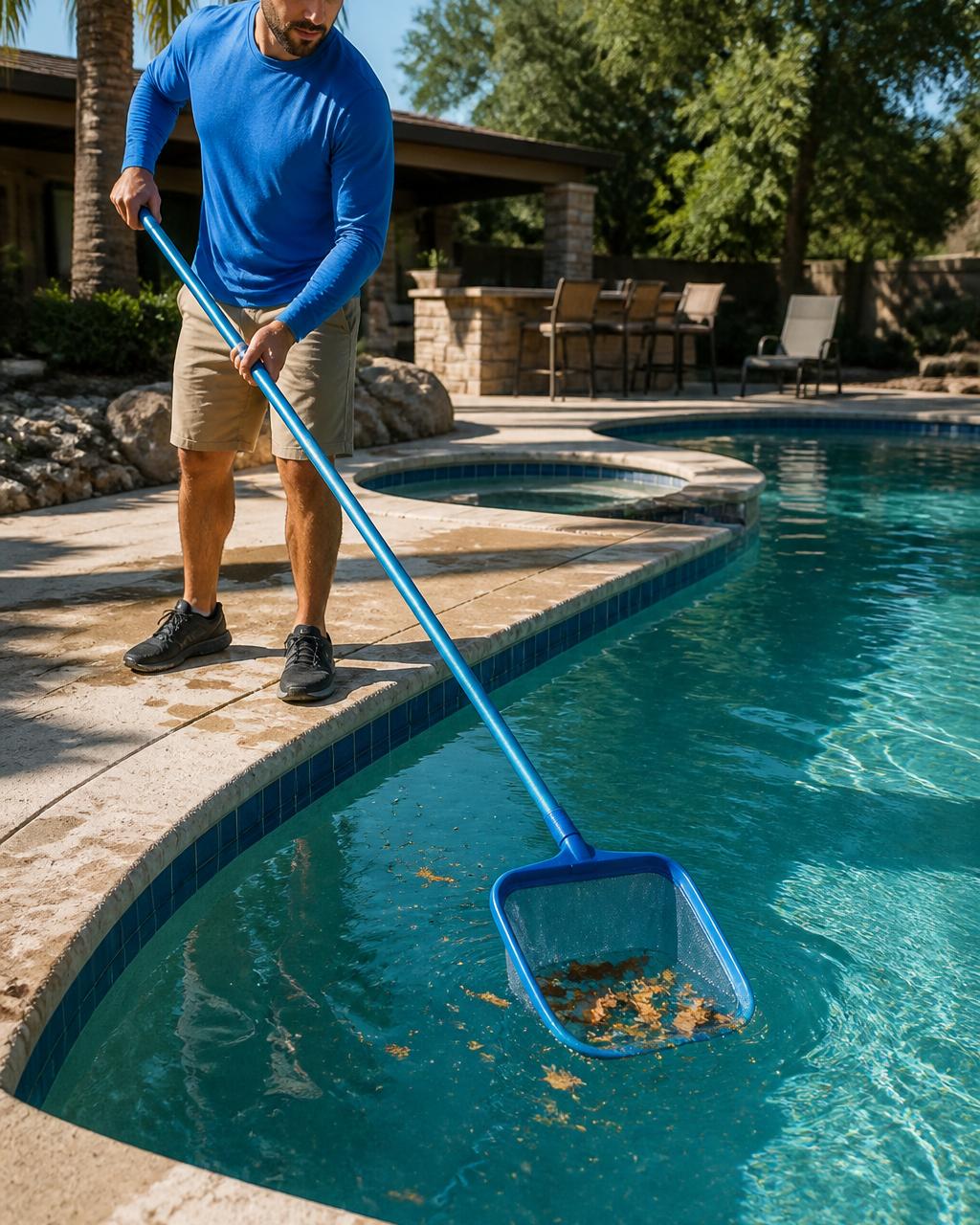
Start each week by removing floating debris from your pool surface. Leaves, pollen, insects, and other debris break down in the water and cloud your pool or feed algae growth.
Skim your pool at least twice per week, more often if you have trees nearby. Use a long-handled skimmer net and work around the pool edges where debris collects.
Don't skip this step even if your pool looks clean. Debris that sinks to the bottom still needs to be vacuumed, which takes longer. Surface skimming is the easiest prevention.
Brushing Pool Surfaces
Brush your pool walls, steps, and floor at least once per week. Brushing removes algae before it can take hold and keeps surfaces from becoming slippery or stained.
Use a pool brush with stiff bristles. Work from the top of the walls down toward the floor. Pay special attention to corners and shaded areas where algae loves to hide.
Brush around ladders, steps, and any equipment that sits in the pool. These spots trap debris and algae.
Vacuuming the Pool Floor
After brushing, vacuum the pool floor to remove debris that settled on the bottom. Connect your pool vacuum to the pump and work slowly across the floor in overlapping rows.
Vacuuming should take 15 to 20 minutes depending on your pool size. Don't rush this step. Moving slowly ensures you pick up all the debris instead of just pushing it around.
Emptying Baskets and Checking Equipment
Your skimmer basket and pump basket fill with debris as your filter runs. Empty them at least once per week, more often if debris is heavy.
A clogged basket forces your pump to work harder and reduces water circulation. Poor circulation leads to algae and cloudy water.
While you're checking baskets, do a quick visual inspection of your equipment:
- Look for leaks around the pump
- Check that water is flowing smoothly through the filter
- Listen for unusual sounds from the pump
Pool Water Testing Schedule and Why It Matters
Testing your water weekly is the foundation of pool maintenance. You can't balance your water chemistry if you don't know what the numbers are.
Water chemistry keeps your pool safe for swimmers and protects your equipment from damage. Imbalanced water can cause cloudy water, algae growth, equipment corrosion, and skin irritation.
When to Test Your Water
Test your pool water at least once per week. The best time is in the morning before anyone swims. This gives you time to make adjustments before the pool is used.
If you have heavy pool usage or recent rain, test more often. Rain dilutes your chemicals and changes pH. Heavy swimming increases demand on your chlorine. Many pool owners test twice per week during summer months when the pool gets heavy use.
What to Test For and Target Ranges
Your weekly pool maintenance checklist should include testing for these four core parameters:
Free Chlorine: 2-4 ppm (parts per million) for residential pools
- This is the chlorine available to kill bacteria and algae
- Saltwater pools may run 1-3 ppm because salt chlorine generators produce chlorine continuously
- Test more frequently (2-3 times weekly) during peak summer use or after heavy rain
pH Level: 7.2-7.6
- Measures how acidic or basic your water is
- Chlorine works most effectively in this range
- pH below 7.2 can corrode equipment and irritate skin; above 7.6 reduces chlorine effectiveness and can cause cloudy water
Total Alkalinity: 80-120 ppm
- The water's ability to resist pH changes
- Acts as a buffer; without adequate alkalinity, pH swings wildly after chemical adjustments
- Low alkalinity (below 60 ppm) makes pH unstable; high alkalinity (above 180 ppm) makes pH difficult to lower
Stabilizer (Cyanuric Acid): 30-50 ppm for outdoor pools
- Protects chlorine from sun damage (UV degradation)
- Indoor pools do not need stabilizer
- Once stabilizer is added, it accumulates and rarely needs adjustment; test only monthly or quarterly after the initial season
Choosing a Test Method
Use a reliable test kit. Digital testers (electronic meters) are more accurate than test strips and provide precise readings within seconds. Test strips are convenient for quick checks but are less accurate, especially for pH and alkalinity.
Record your test results in a maintenance log. Tracking trends helps you spot problems before they get serious, for example, if pH consistently drifts upward every week, you may have a circulation issue or need to adjust your alkalinity.
Balancing pH and Free Chlorine Levels
After testing your water, you may need to adjust chemicals. This is where many pool owners get nervous, but it's straightforward once you understand the basics and follow safe handling practices.
Your pool needs the right balance of chlorine to kill bacteria and algae. It also needs proper pH so the chlorine works effectively and swimmers stay comfortable.
Safe Chemical Handling Fundamentals
Before adding any chemicals:
- Read the product label every time. Dosing instructions vary by product strength and pool volume.
- Never mix chemicals. Add one chemical at a time, wait 24 hours, retest, then add the next if needed. Mixing chlorine with pH adjusters or other products can create dangerous reactions.
- Wear gloves and eye protection when handling pool chemicals. Chlorine and pH adjusters are caustic and can burn skin and eyes.
- Add chemicals to the water, never water to chemicals. Pouring water into concentrated chemicals can cause violent reactions.
- Store chemicals in a cool, dry place away from sunlight, moisture, and other chemicals. Keep them in their original labeled containers.
- Keep chemicals away from children and pets.
Adjusting Free Chlorine
If your free chlorine is low (below 2 ppm):
- Calculate your pool volume in gallons (length × width × average depth × 7.5).
- Check the product label for dosing: most chlorine products specify how much to add per 10,000 gallons to raise chlorine by 1 ppm.
- Add the calculated amount to the deep end of the pool while the pump is running. This distributes the chlorine evenly.
- Wait 24 hours, then retest.
- If chlorine is still low, repeat the process.
If your free chlorine is high (above 4 ppm), simply stop adding chlorine and allow the sun to naturally reduce it over a few days. Chlorine dissipates in sunlight. Do not drain the pool to lower chlorine.
Adjusting pH
If pH is low (below 7.2), add pH increaser (sodium carbonate) according to the product label. If pH is high (above 7.6), add pH decreaser (sodium bisulfate) according to the product label.
Important: Always adjust pH before adjusting alkalinity. pH changes affect alkalinity readings, so testing and adjusting in the wrong order leads to overcorrection.
Make small adjustments. Most products raise or lower pH by 0.2-0.4 per dose. Retest after 24 hours. Large pH swings suggest a bigger problem, like a leak, heavy rain, or equipment failure, consult a professional if pH won't stabilize.
Order of Operations for Multiple Adjustments
If both pH and chlorine are out of range:
- Adjust pH first (if needed).
- Wait 24 hours and retest both pH and chlorine.
- Adjust free chlorine (if still needed).
- Wait 24 hours and retest before allowing swimmers back in the pool.
This sequence prevents chemical interactions and ensures accurate readings.
When to Call a Professional
If you are unsure about dosing, uncomfortable handling chemicals, or if water chemistry won't stabilize after two adjustment cycles, contact a professional. Persistent imbalances often signal equipment problems, such as a faulty pump, filter leak, or circulation issue, that require diagnosis beyond simple chemical adjustment.
How to Shock a Pool: When and Why
Shocking your pool means adding a large dose of chlorine to kill stubborn bacteria and algae. It's different from your regular chlorine maintenance.
You should shock your pool:
- After heavy rain
- After heavy swimming
- If you see algae growth
- If water turns cloudy or green
Shock your pool in the evening so the chlorine can work overnight without being burned off by the sun. Follow the product instructions for dosage based on your pool volume.
After shocking, test your chlorine level before anyone gets in the water.
Pool Filter Cleaning Schedule and Maintenance
Your filter is the heart of your pool's circulation system. A clean filter keeps water clear and reduces the load on your pump.
Check your filter pressure gauge weekly. Most filters operate best at 10 to 20 pounds per square inch (PSI). When pressure rises above 25 PSI, it's time to clean the filter.
Backwash your filter or clean the filter cartridge according to your filter type. This removes trapped debris and restores flow.
A well-maintained filter runs more efficiently and lasts longer. Neglected filters fail suddenly and cost hundreds to replace.
Using a Pool Maintenance Log Template
Track your weekly pool maintenance in a simple log. Record the date, time, chemicals added, test results, and any problems you notice.
A maintenance log helps you spot patterns. You might notice your pH always drifts up on Sundays after heavy swimming. You'll know to test more often and adjust chemicals proactively.
Your log also protects you. If equipment fails, you have documentation of proper maintenance. This matters for warranty claims.
Keep your log simple:
- Date and time of maintenance
- Test results (chlorine, pH, alkalinity, stabilizer)
- Chemicals added and amounts
- Equipment observations
- Any problems or repairs needed
Digital logs or paper notebooks both work. Use whatever you'll actually keep up with.
When to Call a Professional Pool Service
Some weekly pool maintenance tasks are straightforward for homeowners. Others require professional expertise.
Call a professional if:
- Your water stays cloudy after shock treatment
- You see algae that doesn't respond to shock and brushing
- Equipment makes unusual sounds or leaks
- Your pump or filter stops working
- You're unsure about chemical adjustments
- You want help with complex repairs
EcoClean Pool Services handles everything from routine weekly cleaning to complex equipment repairs. Our technicians can diagnose problems that puzzle homeowners and fix them right the first time.
Many busy professionals choose to outsource weekly pool maintenance entirely. It's one less thing to worry about, and your pool stays in perfect condition.
Keeping up with your weekly pool maintenance checklist keeps your pool clean, safe, and ready to enjoy all season. But if you'd rather spend your weekends swimming instead of maintaining, professional help is just a call away.
Frequently Asked Questions
What should be included in a weekly pool maintenance checklist?
A weekly pool maintenance checklist should include skimming floating debris, brushing pool walls and steps, vacuuming the floor, emptying skimmer and pump baskets, testing water chemistry (pH, free chlorine, alkalinity), checking water level, and visually inspecting the pool deck and equipment for damage. These tasks keep your water safe, clear, and balanced. Most homeowners can complete these tasks in 30 to 60 minutes per week.
How often should you test pool water as part of your testing schedule?
Test your pool water at least once per week during the swimming season. If your pool sees heavy use, test two to three times per week. Testing checks free chlorine (1.0-4.0 ppm), pH (7.2-7.8), and alkalinity (80-120 ppm). Use a test kit or digital tester for accurate results. Regular testing prevents algae, cloudy water, and equipment damage.
What should pool chlorine and pH levels be?
Free chlorine should stay between 1.0-4.0 ppm to sanitize your pool and keep it safe. pH should remain between 7.2-7.8 to balance sanitizer effectiveness and protect your skin and eyes. Alkalinity should be 80-120 ppm to stabilize pH. Test these levels weekly and adjust with appropriate chemicals if readings are outside the target range. Proper balance prevents algae and maintains water clarity.
How often should you shock a pool?
Shock your pool immediately after heavy rain, high bather load, or visible algae. Shocking raises free chlorine levels rapidly to kill bacteria, algae, and organic contaminants. Follow product instructions for dosing based on your pool volume. Shock in the evening and wait 24 hours before swimming.


Comments
Post a Comment